
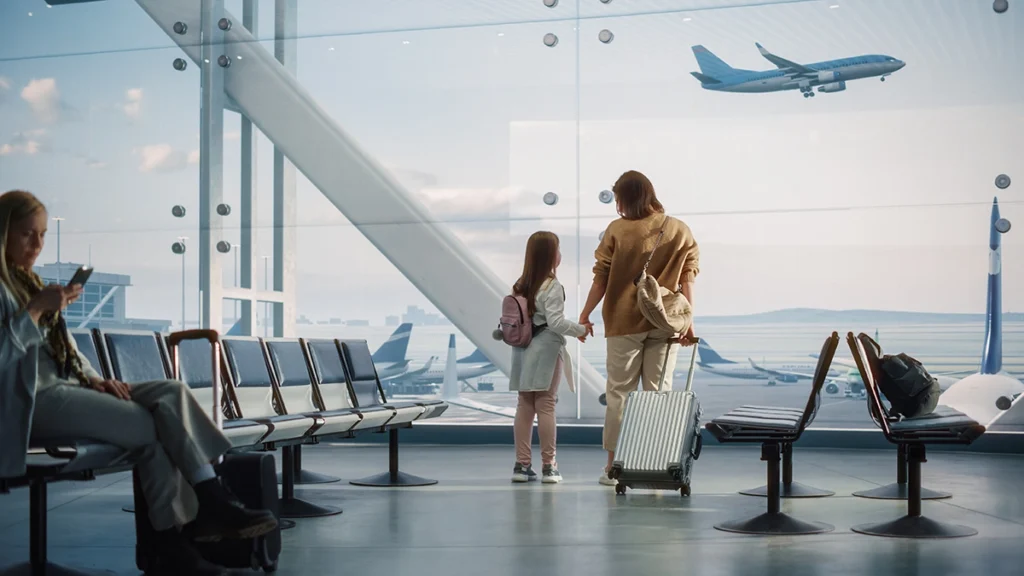
First Flight with a Child – How to Prepare Them?
A child’s first flight can be exciting, but it can also involve many unfamiliar experiences at once.
A large airport. Security checks. Crowds. Loud announcements. Waiting. Takeoff. Changes in air pressure. A view from thousands of feet above the ground.
For an adult, most of these stages are predictable. A child may have no idea what the sentence “We’re going to fly on a plane” actually means.
One of the best ways to prepare a child for their first flight is to explain what will happen step by step. Tell them what the airport may look like, what happens during takeoff and landing, and what they might experience while they are on the plane.
There is no need to turn it into a long lesson.
A few simple explanations can make an unfamiliar experience feel much more predictable.
When Should You Tell a Child About Their First Flight?
Tell your child early enough to give them time to become familiar with the idea, but there is usually no need to start preparing months in advance.
The right moment depends on the child’s age and how they react to new experiences.
One child may be happy with a short conversation a few days before the trip. Another may want to:
- see what an airplane looks like,
- look at pictures of an airport,
- know where they will sit,
- ask questions about every stage of the journey.
It is usually better to introduce information gradually.
You do not need to explain security screening, takeoff, pressure changes, turbulence, baggage collection and landing during one conversation.
Return to the topic naturally as the trip approaches.
How Do You Explain Flying to a Child?
The easiest way is to describe flying as a sequence of events rather than focusing only on being high in the air.
You can explain:
- We will travel to the airport.
- We may check in some of our luggage.
- We will go through security.
- We will find our gate.
- We will wait for boarding.
- We will get on the plane.
- We will find our seats and fasten our seat belts.
- The plane will take off.
- We will fly to our destination.
- The plane will land.
- We will leave the plane and collect our luggage if necessary.
For younger children, you can even draw a simple sequence:
🚗 → 🧳 → 🔍 → ✈️ → 🛬 → 🧳
It answers one of the most important questions children often have:
“What happens next?”
Should You Show a Child an Airplane Before Their First Flight?
Yes. Photos or videos of an ordinary passenger plane can help a child understand what they will see during the journey.
You can show them:
- the outside of an airplane,
- the cabin,
- passenger seats,
- overhead luggage compartments,
- windows,
- seat belts.
There is no need to show dramatic videos of turbulence, emergency situations or difficult landings.
The aim is to make a normal flight more familiar.
If you have an airport viewing area nearby, watching planes take off from the ground can also be a fun introduction.
Is Pretend Play Helpful Before a First Flight?
Yes. Pretend play can help younger children understand the order of events without requiring a long explanation.
Chairs can become airplane seats.
A backpack can become luggage.
A teddy bear can become a passenger.
You can play through a simple journey:
“First, security.”
“Now we find our seat.”
“Fasten your seat belt.”
“The plane is taking off.”
“We’re flying.”
“Now we’re landing.”
The game does not need to be realistic.
Its purpose is to make the experience more predictable.
How Can You Prepare a Child for the Airport?
Explain that airports can be large, busy and noisy, and that travelling by plane also involves walking and waiting.
You can say:
“There will be lots of people.”
“We might hear loud announcements.”
“We will have to look for signs and numbers.”
“Sometimes we will need to wait.”
Children may be surprised that arriving at an airport does not mean immediately getting onto the plane.
A useful explanation is:
“We have a few things to do at the airport before we can get on our plane.”
How Do You Explain Airport Security to a Child?
Tell your child that some belongings may travel through a scanner separately for a moment, but they will get them back immediately afterwards.
You might say:
“Your backpack will go through a special machine.”
“We will walk through another area.”
“Then we will pick your backpack up again.”
This can be particularly important if the child is carrying:
- a favourite toy,
- a teddy bear,
- a comfort item.
Instead of unexpectedly taking it away, explain what will happen first.
How Can You Prepare a Child for Waiting at the Airport?
Tell them in advance that waiting is a normal part of flying. This helps prevent the expectation that something exciting will happen every minute.
They may need to wait:
- during check-in,
- before or after security,
- at the gate,
- before boarding,
- inside the plane before departure.
A simple sentence works well:
“Sometimes we’ll be walking, and sometimes we’ll be waiting.”
That is often enough to create realistic expectations.
Should You Show a Child Their Boarding Pass?
Older children can look at a boarding pass and use it as part of the travel experience.
You can find together:
- the flight number,
- seat number,
- gate,
- departure time.
There is no need to explain every code.
Turn it into a small mission:
“Can you find our gate number?”
The airport becomes something they can actively navigate rather than simply a place where they follow an adult.
How Do You Prepare a Child for Takeoff?
Explain that the airplane will first move slowly around the airport, then accelerate quickly before lifting into the air.
You can say:
“First the plane will move slowly.”
“Then it will go much faster.”
“You may feel yourself being pushed gently back into the seat.”
“After a moment, we’ll be in the air.”
Knowing this in advance makes the sudden acceleration less surprising.
You do not need to repeatedly say:
“Don’t be scared.”
Instead, explain what is going to happen.
What Might a Child Feel During Takeoff?
During takeoff, a child may notice acceleration, a change in the angle of the plane and pressure changes in their ears. These sensations are usually temporary.
You can explain:
“Your ears might feel blocked for a little while.”
“It can feel a bit like travelling up a mountain.”
“It should get better as the pressure changes.”
Swallowing, drinking or yawning may help some children equalise pressure.
If a child has an ear infection, recent ENT procedure or another relevant medical condition, parents should seek individual medical advice before flying.
How Can You Prepare a Child for Airplane Noise?
Tell them that airplanes can be much louder than cars or trains, particularly during takeoff.
You can say:
“It will get louder when the plane starts taking off.”
“The engines work harder during that part of the flight.”
For a child who is particularly sensitive to noise, it may be worth preparing a suitable solution in advance.
The important point is not to present normal engine noise as a sign that something is wrong.
What Should You Tell a Child About Turbulence?
A simple explanation is enough: airplanes can sometimes move or shake slightly during the flight, which is one reason passengers may be asked to keep their seat belts fastened.
You can compare it with something familiar:
“Sometimes the plane can move a little, like a car driving over a bumpy road.”
“That is why we stay in our seats when the seat belt sign is on.”
There is usually no need to discuss turbulence in detail unless the child asks about it.
How Do You Prepare a Child for Landing?
Tell them that the plane will gradually fly lower, their ears may feel blocked again, and the aircraft will slow down firmly after touching the ground.
You can say:
“We’re starting to go lower now.”
“Your ears might feel a little strange again.”
“When the wheels touch the ground, the plane will slow down.”
Landing can feel more noticeable than cruising because several changes happen close together.
Knowing what to expect can make those sensations easier to understand.
What If a Child Is Afraid of Their First Flight?
Start by finding out what they are actually worried about. Fear of flying can mean very different things to different children.
Ask:
“What part of flying worries you?”
They might say:
“The plane will be too loud.”
Then talk about engine noise.
Or:
“I don’t want my backpack to disappear.”
Then explain airport security again.
Or:
“I don’t know what it feels like to be so high.”
Then talk about the view from the window and what happens during the flight.
A specific fear is easier to address with a specific explanation.
Should You Tell a Child That Flying Is Safe?
Answer questions about safety calmly and factually, but there is no need to repeatedly reassure a child who has not expressed any concern.
Repeatedly saying:
“Don’t worry, planes are safe”
can introduce the idea that there is something they should be worried about.
Instead, focus on normal procedures:
“We keep our seat belts fastened.”
“The crew will tell us when we can stand up.”
“During takeoff and landing we stay in our seats.”
If your child directly asks about safety, answer their question honestly and in an age-appropriate way.
Should a Child Choose Their Seat?
If possible, allowing a child some choice between a window seat and sitting close to a parent can give them a small sense of control over the journey.
A window seat can make it possible to watch:
- airport vehicles,
- takeoff,
- clouds,
- landscapes,
- landing.
But not every child wants to sit next to the window.
There is no reason to force the experience.
Comfort matters more than getting the “best” view.
Should You Show a Child the Flight Route?
Yes. Older children especially can connect their first flight with a map and see where they are actually travelling.
Before departure, show:
Poland → Spain
or:
Warsaw → Rome
If the aircraft has a route map, you can check it during the flight:
“Where are we now?”
After landing:
“We travelled all the way from here to here.”
The flight stops being only a few hours inside an aircraft.
It becomes a real journey across a map.
See also: How to Teach a Child the World Map Through Play.
Should a Child Learn About the Destination Before Flying?
Yes, but a few basic facts are enough to give the journey a clear destination: where the country is, what its flag looks like, which city you are visiting and one or two things you might see there.
A flight then leads somewhere rather than being an isolated event.
You can show:
- the country on a map,
- its flag,
- the destination city,
- one characteristic place.
For broader preparation, see:
How to Prepare a Child for an International Trip.
Can an Educational Activity Book Help Before a First Flight?
Yes. An activity book can connect the journey with the destination and provide a quiet activity before or during the flight.
For example, if you are flying to Japan, before the trip you can:
- find Japan on a map,
- look at its flag,
- learn one interesting fact.
At the airport or on the plane:
- colour a page,
- complete a simple task,
- look for familiar symbols.
After arrival, you can say:
“We’re now in the country we were learning about.”
The activity does not need to distract a child from the experience.
It can simply help connect the journey with the place they are travelling to.
What Should You Pack for a Child on a Plane?
A child’s hand luggage should contain mainly the things they may actually need during the journey: practical essentials, a change of clothes if appropriate and a few small activities.
Useful items may include:
- tissues or wipes,
- a change of clothes,
- a small book,
- colouring pencils,
- colouring or activity pages,
- stickers,
- headphones,
- one small toy,
- a favourite comfort item,
- suitable snacks.
Important documents, medication and essential travel items should remain under adult supervision.
Always check current airline and airport rules regarding liquids, food and luggage before travelling.
Should a Child Have Their Own Backpack?
A small backpack can work well if the child can comfortably carry it themselves.
Let them choose a few light items:
“Which book do you want to bring?”
“Would you rather take stickers or a colouring book?”
“Which teddy is travelling with us?”
This gives them a little responsibility and control.
The backpack should not become an adult suitcase transferred onto a child’s shoulders.
A few light items are enough.
What Activities Work Well on a Plane?
The best airplane activities are small, quiet and easy to stop whenever the child needs to fasten their seat belt or put the tray table away.
Good options include:
- colouring,
- activity books,
- stickers,
- drawing,
- simple riddles,
- books,
- question cards,
- picture-search activities.
Try to avoid games with dozens of small pieces.
Collecting tiny parts from underneath airplane seats is rarely enjoyable.
It is also worth keeping some activities hidden until later rather than presenting everything immediately.
How Do You Keep a Child Entertained During a Flight?
You do not need to plan every minute. Mix different kinds of activities and leave room for watching the plane, talking and simply resting.
A child can:
- watch takeoff,
- look through the window,
- find shapes in the clouds,
- follow the route,
- draw,
- read,
- complete an activity,
- listen to an audiobook,
- rest.
If a child is happily looking out of the window, there is no need to immediately offer another activity.
Not every moment of boredom needs to be fixed either.
Sometimes that is when children invent their own games.
Should You Bring New Toys for the Flight?
One or two new activities can be useful during a longer journey, but not everything should be unfamiliar.
A good combination is:
something familiar + something new.
For example:
- a favourite book,
- a familiar teddy,
- a new activity booklet.
Familiar items provide comfort.
A new activity can become useful when the journey starts to feel long.
Is Screen Time on a Plane a Bad Idea?
No. A phone or tablet can be one of several ways to spend time during an unusual and potentially long journey.
You can prepare:
- a movie,
- a cartoon,
- an audiobook,
- music,
- an offline game.
Download content in advance if internet access will not be available, and remember headphones.
There is no need to choose between:
“educational activities only”
and
“a screen for the entire flight.”
Both can have a place.
A flight is not an ordinary day at home.
What If a Child Gets Bored on the Plane?
Before offering another activity, consider whether the child is actually bored or whether they are tired, hungry, restless or overwhelmed.
Ask:
“Would you like to do something, or do you want to rest for a while?”
You can rotate types of activities:
- after colouring → conversation,
- after screen time → looking outside,
- after reading → a snack,
- after riddles → rest.
This prevents the flight from turning into a rigid programme of entertainment.
How Do You Prepare a Child for Sitting Still?
Explain that passengers need to stay in their seats for significant parts of the flight, particularly during takeoff, landing and whenever the seat belt sign is on.
You can say:
“When the seat belt sign is on, we stay in our seat.”
“Sometimes we’ll be able to get up, but not always.”
For active children, long periods of sitting may be more difficult than flying itself.
If possible, allow some movement before boarding instead of expecting them to sit quietly at the gate for an additional hour.
How Do You Prepare a Child for the Airplane Toilet?
Tell them that the toilet will be small and may look and sound different from the bathroom at home.
The flush can be particularly loud.
You can say:
“The toilet will be very small.”
“The flushing sound might be loud.”
“That’s normal.”
With younger children, using the toilet before boarding may also be helpful.
What About Food During the Flight?
Bring simple, familiar food where possible, while following current airline, airport and destination rules.
A child’s first flight is not necessarily the best moment to experiment with unfamiliar food.
Before travelling, check current restrictions regarding:
- liquids,
- food,
- baby food,
- specific products carried across borders.
These rules may vary by airport, airline and destination.
What Helps With Blocked Ears on a Plane?
Changes in cabin pressure during takeoff and especially descent can cause blocked ears or discomfort. Swallowing, yawning or drinking may help equalise pressure.
Tell your child:
“If your ears feel strange or uncomfortable, let me know.”
Do not promise:
“It definitely won’t hurt.”
Every child reacts differently.
If a child has an ear infection, significant ear pain or a relevant medical history, ask a healthcare professional for advice before flying.
What Should You Do If a Child Cries During the Flight?
Try to identify the reason rather than focusing primarily on whether other passengers are being disturbed.
Possible causes include:
- ear discomfort,
- tiredness,
- hunger,
- fear,
- noise,
- frustration,
- too much sitting,
- sensory overload.
The useful question is not:
“How do I make them stop crying?”
but:
“What do they need right now?”
A first flight is a completely new environment, and children may react differently than they do in a car or train.
What If a Child Becomes Scared During the Flight?
Refer to what is happening in that specific moment instead of telling them that they should not be afraid.
During takeoff:
“The plane is speeding up now, just like we talked about.”
During landing:
“That sound means the plane is getting ready to land.”
If the plane moves:
“It’s moving a little. We’re staying seated with our seat belts on.”
The child can connect the real experience with what they learned beforehand.
How Do You Prepare a Child to Sleep on a Plane?
If the flight overlaps with the child’s usual sleep time, bring a few familiar elements of their bedtime routine, but do not assume they will definitely sleep.
Useful items may include:
- a favourite comfort toy,
- a familiar audiobook,
- comfortable clothes,
- part of their usual bedtime routine.
An airplane is still a different environment.
There is light, noise, people and excitement.
A child who normally falls asleep easily may stay awake.
Another may fall asleep shortly after takeoff.
Prepare for both possibilities.
How Do You Prepare for a Flight Delay with a Child?
Assume that the total journey may take longer than the scheduled flight time and avoid using every snack and activity immediately.
If there is a delay, explain simply:
“Our flight is leaving later.”
“We need to stay here for a while.”
“When we know more, I’ll tell you.”
Do not promise an exact departure time if you do not know it.
How Should You Explain a Change of Plan?
Give the child three pieces of information: what changed, what you are doing now and what will happen next.
For example:
“Our flight is delayed.”
“We’re staying near this gate.”
“When boarding starts, we’ll go onto the plane together.”
A child does not need every operational detail.
They need an answer to:
“What happens now?”
What Happens After Landing?
Explain that landing does not always mean the journey is completely finished. You may still need to leave the aircraft, walk through the terminal, collect luggage and continue to your accommodation.
A child may assume:
“We landed = we have arrived.”
Instead, explain the next step:
“The plane has landed. Now we’ll get off, collect our suitcase and then travel to the hotel.”
Again, focus on the next stage rather than the entire rest of the day.
Should You Talk About the Flight Afterwards?
Yes. A short conversation after the journey can help a child organise the experience and make future flights more predictable.
You can ask:
“What did you like most?”
“What was different from what you expected?”
“What surprised you?”
“What would you bring next time?”
You might learn:
“The takeoff was fun.”
“I didn’t like the noise.”
“I thought the plane would be bigger.”
“The clouds were the best part.”
Those answers can help you prepare for the next journey.
Can a First Flight Help a Child Understand Geography?
Yes. Flying gives real context to concepts that may otherwise feel abstract, including countries, cities, distance and location.
Before travelling:
“Here we are.”
“This is where we’re going.”
After the trip:
“We really travelled from here to here.”
An older child can then:
- find both cities,
- trace the route,
- compare distances,
- look at countries crossed along the way.
A map starts representing something the child has personally experienced.
What Should You Avoid Before a Child’s First Flight?
Avoid turning preparation into a long list of warnings. The aim is to make the journey more predictable, not to introduce new fears.
Try not to:
- repeatedly ask whether the child is afraid,
- tell frightening travel stories,
- show dramatic aviation videos,
- explain turbulence in unnecessary detail,
- promise that nothing will feel uncomfortable,
- present airport security as frightening,
- expect the child to enjoy every stage.
Preparation can remain factual:
“It may be noisy.”
“We may have to wait.”
“Your ears might feel blocked.”
Those are explanations, not warnings.
What Are the Most Common Mistakes During a Child’s First Flight?
The most common problems usually come from unrealistic expectations rather than a lack of special gadgets.
Common mistakes include:
- not explaining the airport process,
- packing too many toys,
- using every activity before takeoff,
- planning every minute,
- expecting perfect behaviour,
- ignoring tiredness,
- transferring adult stress to the child,
- presenting the flight as a test of bravery.
The first flight does not need to be perfect.
It gives the child a reference point for future journeys.
First Flight with a Child – Checklist
Preparing for a child’s first flight can be reduced to a few simple steps.
- Tell the child where you are going.
- Show the destination on a map.
- Explain what happens at the airport.
- Show them what the inside of a plane looks like.
- Explain takeoff and landing simply.
- Mention noise and possible ear pressure.
- Tell them that waiting is part of the journey.
- Prepare several small activities.
- Bring a familiar comfort item if needed.
- Do not use every activity immediately.
- Prepare for possible delays.
- Explain each next stage after landing.
- Return to the map after the trip and talk about the experience.
Frequently Asked Questions About a Child’s First Flight
How Do I Prepare My Child for Their First Flight?
Explain the journey step by step before travelling. Talk about the airport, security, waiting, takeoff, noise, possible pressure in the ears and landing. Keep the explanation short and suitable for the child’s age.
What Should I Tell My Child Before Their First Flight?
Explain what will happen in order: travelling to the airport, passing through security, waiting at the gate, boarding, finding your seats, taking off, flying and landing.
What Should I Pack for a Child on a Plane?
Bring a few small activities, practical essentials and familiar items. Books, colouring pages, pencils, stickers and headphones can work well. Check current airline and airport rules for food, liquids and luggage before travelling.
How Can I Keep My Child Entertained on a Plane?
Prepare several different activities and introduce them gradually. Mix colouring, books, puzzles, audiobooks, screen time, looking through the window and following the flight route.
What Should I Do If My Child Is Afraid of Flying?
Ask what specifically worries them. A child may be concerned about noise, takeoff, height, turbulence or simply not knowing what will happen. Address the specific concern rather than repeatedly saying there is nothing to fear.
How Do I Prepare My Child for Takeoff?
Explain that the plane will first move slowly, then accelerate quickly and lift into the air. Mention the louder engine noise, the feeling of being pushed into the seat and possible pressure changes in the ears.
Why Do Children’s Ears Feel Blocked on a Plane?
Cabin pressure changes as an aircraft climbs and descends. This can cause blocked ears or discomfort. Swallowing, drinking or yawning may help equalise pressure.
Is It Okay to Let a Child Use a Tablet During a Flight?
Yes. A tablet can be one of several activities during a long journey. Download content in advance if necessary and bring headphones.
How Should I Explain Turbulence to a Child?
A simple explanation is enough: sometimes the plane moves a little during the flight, and passengers stay seated with their seat belts fastened when instructed.
Should My Child Have Their Own Backpack?
A small, lightweight backpack can be useful if the child can comfortably carry it. Let them choose a few personal items such as a book, teddy or activity booklet.
What Should I Do If the Flight Is Delayed?
Explain what has changed and what will happen next. Keep some snacks and activities for later instead of using everything immediately after arriving at the airport.
How Can I Prepare My Child for an International Flight?
In addition to preparing for the flight itself, show the destination on a map, look at the country’s flag and introduce a few things your child may see there.
Summary
A child’s first flight does not have to be a complete leap into the unknown.
They do not need to understand everything about air travel.
They mainly need answers to a few questions:
Where are we going?
What will happen at the airport?
What will takeoff feel like?
Why do I need to stay in my seat and wear a seat belt?
What will we do during the flight?
What happens after landing?
The more predictable the sequence becomes, the easier it is for a child to understand a completely new situation.
A first flight can also become more than transportation.
For the first time, a child may see that a place previously shown with a finger on a map is somewhere they can actually reach.
We are here.
We are flying there.
And a few hours later:
Now we are there.
That is a very concrete way of connecting travel with discovering the world.
Prepare for the Destination, Not Only the Flight
Prepare not only for the flight, but also for the place you are flying to.
Nice Family educational activity books help children discover countries through maps, interesting facts, illustrations, colouring and activities.
Selected pages can be used:
- before travelling,
- while waiting at the airport,
- during the flight,
- after arriving at the destination.
This way, the journey can begin before you even board the plane.