
Japan for Kids – Map, Flag, Facts and Places
Japan may remind children of anime, sushi, cherry blossoms, high-speed trains or its distinctive red-and-white flag.
But where exactly is Japan?
What does it look like on a map?
Why is it made up of islands?
What is its capital?
And does all of Japan look like Tokyo?
A good way to explore Japan with children is step by step: first find it on a map of Asia, then discover its capital and flag, and gradually explore its landscapes, places, language and culture.
This way, Japan becomes more than a collection of separate facts.
A simple structure begins to form:
Asia → Japan → Tokyo → map → flag → places → facts
Where Is Japan?
Japan is located in East Asia, in the Pacific Ocean, east of the Korean Peninsula and China. It is an island country, which means its territory is made up of islands.
When using a map, start with the bigger picture.
First:
Asia.
Then:
China.
The Korean Peninsula.
And farther east:
Japan.
A child can immediately notice that Japan is not connected by land to mainland Asia.
This creates a useful question:
“What does it mean when a country is an island country?”
Is Japan an Island?
Japan is not a single island. It is an island country made up of many islands.
This distinction is useful because children may simply say:
“Japan is an island.”
A more accurate explanation is:
Japan is an island country.
Its territory includes several main islands as well as many smaller ones.
The four largest and best-known main islands are:
- Honshu,
- Hokkaido,
- Kyushu,
- Shikoku.
There is no need to memorise all of them immediately.
At first, it is enough to understand:
“Japan is not one single piece of land. It consists of many islands.”
What Does Japan Look Like on a Map?
Japan has a long, narrow shape extending roughly from north to south along the eastern edge of Asia.
A child may notice that the country looks like a curved chain of islands.
This makes Japan particularly interesting to explore on a map because its shape is quite distinctive.
You can ask:
“Is Japan longer or wider?”
“Is it located on the mainland?”
“What is between Japan and mainland Asia?”
The purpose is not to test the child.
It is to show that a map can be used to discover information.
Which Continent Is Japan In?
Japan is in Asia, more specifically East Asia.
This is one of the most important basic connections:
Japan → Asia
Later, more connections can be added:
Japan → Tokyo
Japan → flag
Japan → Mount Fuji
If your child is still discovering the continent itself, this is a natural place to explore “Asia for Kids – Countries, Places and Interesting Facts”.
What Is the Capital of Japan?
The capital of Japan is Tokyo, one of the country’s largest and best-known cities.
Instead of stopping at:
“Japan – Tokyo,”
find Tokyo on a map.
You can say:
“This is Japan.”
“And this is where Tokyo is.”
The child can then see the relationship:
Asia → Japan → Tokyo
rather than memorising two disconnected names.
Is Tokyo the Largest City in Japan?
Tokyo is Japan’s largest metropolitan area and forms part of one of the world’s largest urban concentrations.
For a child, however, the exact population figure is less important than understanding the contrast.
Show a picture of Tokyo.
Tall buildings.
Trains.
Busy streets.
Lights.
Then show a quiet rural or mountain landscape.
Ask:
“Does all of Japan look like Tokyo?”
Of course not.
This helps prevent a common oversimplification:
Japan = Tokyo.
What Does the Japanese Flag Look Like?
The flag of Japan is white with a red circle in the centre.
It is one of the national flags children can often learn to recognise quite easily.
The red circle is associated with the sun.
A child can draw the flag very simply:
a white rectangle,
a red circle in the centre.
But it is useful to go beyond recognising the image.
Ask:
“Which country does this flag belong to?”
“Which continent is that country in?”
“Can you find Japan on the map?”
Now the connection becomes:
flag → Japan → Asia
rather than simply memorising a symbol.
Why Is Japan Associated With Cherry Blossoms?
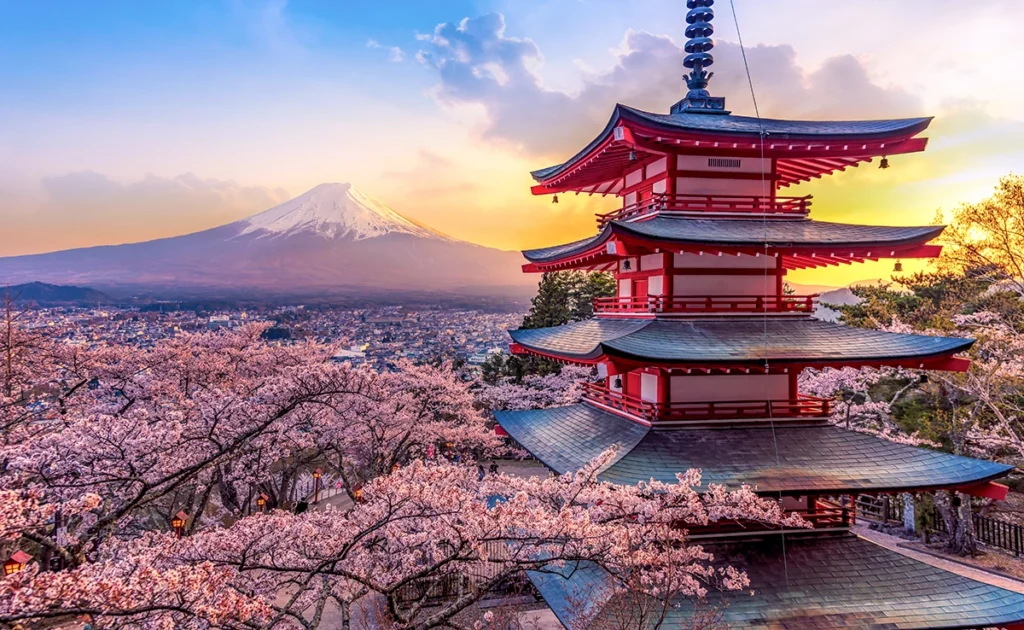
Cherry blossoms, known as sakura in Japanese, are strongly associated with spring and Japanese culture.
For children, this creates a simple visual connection:
🌸 → Japan
But it is important to make clear that Japan is much more than cherry blossoms.
Sakura is one of many symbols and cultural associations connected with the country.
What Is Sakura?
Sakura is the Japanese word commonly used for cherry blossoms, one of the most recognisable symbols of spring in Japan.
During the flowering season, cherry trees become covered with delicate blossoms.
The topic can inspire a simple activity.
Children can:
- draw a cherry blossom branch,
- find Japan on a map,
- talk about when spring occurs,
- compare seasons in Japan with seasons at home.
One interesting fact can therefore lead to geography, nature and culture.
Does Japan Have Four Seasons?
Much of Japan experiences four distinct seasons, although climate conditions vary considerably because the country stretches a long way from north to south.
This can be particularly interesting for children.
Northern Japan may look completely different in winter from the country’s southern islands.
You can ask:
“Why can different parts of the same country have different weather?”
The question can lead naturally to:
- location,
- the shape and length of the country,
- latitude,
- climate.
There is no need to introduce every concept at once.
Are There Mountains in Japan?
Yes. Japan is a mountainous country, and mountains cover a large part of its land area.
This is worth showing because children who mainly see pictures of Tokyo may imagine Japan as a country dominated by huge cities.
In reality, Japan also has:
- mountains,
- forests,
- lakes,
- coastlines,
- rural areas.
It is therefore a great country for comparing:
big city ↔ nature
What Is Mount Fuji?
Mount Fuji is the highest mountain in Japan and one of the country’s most recognisable landmarks.
Its distinctive shape appears in:
- photographs,
- illustrations,
- postcards,
- art.
A child can easily build the association:
Japan → Mount Fuji
But it is worth going one step further.
“Where is Mount Fuji?”
“Is it in Tokyo?”
“Does Japan have other mountains?”
A familiar landmark becomes the beginning of further exploration.
Is Mount Fuji a Volcano?
Yes. Mount Fuji is a volcano.
This may immediately lead to another question:
“Why does Japan have volcanoes?”
There is no need to turn the answer into a geology lesson.
You can simply explain that Japan is located in a part of the world with significant geological activity.
That is enough for a first introduction.
Are There Earthquakes in Japan?
Yes. Japan lies in a region with high seismic activity, so earthquakes occur there more frequently than in many other parts of the world.
For children, this topic should be presented calmly and factually.
There is no need to show dramatic footage.
Instead, explain:
“Earthquakes are one of the natural hazards people prepare for in Japan, so buildings and safety procedures take them into account.”
This also shows children an important geographical relationship:
where people live can influence how buildings and cities are designed.
Does Japan Have Access to the Ocean?
Yes. Japan is an island country surrounded by the Pacific Ocean and neighbouring seas.
This is very easy to see on a map.
Try a simple activity:
“Find the land.”
“Find the water.”
“Does Japan share a land border with another country?”
No.
This distinguishes Japan from many countries children may already know in Europe.
Does Japan Border Any Other Countries?
Japan does not share land borders with other countries because it is an island nation.
However, several countries are relatively nearby.
On a map, children can find:
- South Korea,
- North Korea,
- China,
- Russia.
Then ask:
“Which of these countries is closest to Japan?”
Again, the child is using the map rather than simply memorising names.
What Language Is Spoken in Japan?
The main language spoken in Japan is Japanese.
Children do not need to start learning the language to explore the country.
However, you can show them that written Japanese looks very different from the Latin alphabet used in English and many other languages.
That immediately creates another question:
“How do people write in Japanese?”
And another part of Japan is ready to explore.
What Does Japanese Writing Look Like?
Written Japanese uses several writing systems, including kanji characters and the hiragana and katakana syllabaries.
For a child, a simpler explanation is enough:
“Japanese is not written using only the same letters we use in English.”
Show a few examples.
There is no need to memorise them.
The goal is to notice that people around the world use different writing systems.
How Do You Say “Hello” in Japanese?
One of the best-known Japanese greetings is:
konnichiwa
It can be treated as a fun fact rather than a language lesson.
Learning just one word gives the child another connection:
Japan → Japanese → konnichiwa
What Is Japanese Food Like?
Japanese cuisine is diverse and includes much more than sushi.
Sushi is often one of the first foods children associate with Japan.
But you can also introduce examples such as:
- ramen,
- onigiri,
- tempura,
- different rice and noodle dishes.
There is no need to turn this section into a complete guide to Japanese cuisine.
Food is one part of exploring a country.
It does not define the whole country.
Does Everyone in Japan Eat Sushi Every Day?
No. Sushi is part of Japanese cuisine, but that does not mean everyone in Japan eats it every day.
This is a useful opportunity to talk about stereotypes.
One famous food does not describe the everyday diet of an entire population.
The same principle applies when learning about any country or region.
Is Japan a Modern Country?
Japan is a highly developed country where modern technology and infrastructure exist alongside traditions and historic places.
This contrast can be particularly interesting for children.
On one side:
- high-speed trains,
- large cities,
- modern technology.
On the other:
- temples and shrines,
- traditional gardens,
- historic buildings,
- long-standing customs.
There is no need to choose between:
“modern Japan”
and
“traditional Japan.”
Both are part of the country.
What Are Shinkansen Trains?
Shinkansen is Japan’s high-speed railway network, widely known for connecting major cities efficiently.
For children, trains can become another entry point into geography.
“How do people travel between large Japanese cities?”
“Where does the train go?”
“Can we find those cities on the map?”
The topic connects:
transport → cities → distance → map
Does Japan Have Many Large Cities?
Yes. Japan has many large cities, but much of the country also consists of mountains, smaller communities and natural landscapes.
Besides Tokyo, children may encounter names such as:
- Osaka,
- Kyoto,
- Yokohama,
- Nagoya.
There is no need to memorise them all.
The main idea is:
Tokyo ≠ all of Japan.
What Is the Difference Between Tokyo and Kyoto?
Tokyo is Japan’s capital and a huge modern urban centre, while Kyoto is particularly well known for its historic heritage, temples and shrines.
This is, of course, a simplification for children.
It does not mean Tokyo has no history or Kyoto is not a modern city.
The contrast simply helps children understand that Japanese cities can look different and have different characteristics.
What Places in Japan Should Children Find on a Map?
Start with a few very different places that show children how varied Japan is.
A useful first set includes:
- Tokyo,
- Kyoto,
- Mount Fuji,
- Hokkaido,
- Okinawa.
Why these examples?
Because together they show:
a large city,
a historic city,
a mountain,
the north of the country,
southern islands.
The child begins to see variety rather than one single image of Japan.
What Is Hokkaido?
Hokkaido is the northernmost of Japan’s four main islands.
It is easy to spot on a map above the main island of Honshu.
Ask:
“Could northern Japan be colder than southern Japan?”
This creates a natural transition into climate.
What Is Okinawa?
Okinawa is the name of both a Japanese prefecture and one of its islands, while the wider region includes islands located far south of Japan’s main islands.
For a child, the key idea is simple:
Japan stretches a long way from north to south.
Hokkaido and Okinawa make this particularly easy to see on a map.
Does All of Japan Look the Same?
No. Japan includes huge cities, mountains, forests, coastlines, rural areas and islands with different climate conditions.
This is one of the most important ideas in the article.
If a child knows Japan mainly through anime or pictures of Tokyo, their image of the country may be quite narrow.
Maps and varied photographs help expand it.
Why Is Japan Interesting for Learning Geography?
Japan combines several geographical features that are easy for children to identify: it is an island country, has a distinctive shape, lies in East Asia, is mountainous and stretches a long distance from north to south.
One country can therefore introduce children to:
- continents,
- islands,
- oceans,
- mountains,
- cities,
- climate,
- distance.
Japan becomes a starting point for understanding several basic geographical ideas.
How Should You Avoid Teaching Kids About Japan?
One of the biggest mistakes is reducing Japan to a few popular associations such as anime, sushi, samurai and cherry blossoms.
Those things can be a starting point.
They should not be the end.
Avoid broad statements such as:
“Japanese people always…”
“Everyone in Japan…”
“Japan is the country of anime.”
More accurate language would be:
“Anime is one part of Japanese popular culture.”
“Sushi is one part of Japanese cuisine.”
“Cherry blossoms are strongly associated with spring in Japan.”
Precise language helps children discover a country without reducing it to stereotypes.
Tak, angielska wersja ma jeszcze Part 2 i Part 3, bo polska była w trzech częściach. Lecimy więc z Part 2, bez ponownego H1 i bez powtarzania meta danych.
How Can Kids Explore Japanese Culture Without Stereotypes?
The best approach is to present Japanese culture as a combination of traditions, modern life, regional differences and everyday experiences rather than reducing it to a few famous symbols.
Children may associate Japan with:
- sushi,
- anime,
- samurai,
- cherry blossoms,
- temples,
- high-speed trains.
These are useful starting points.
But it is worth adding:
“These are only a few parts of Japan. The country is much more diverse.”
Just as Poland cannot be described only through pierogi and castles, Japan cannot be explained through sushi and anime alone.
What Are Torii Gates?
Torii are distinctive gates most commonly found at the entrances to Shinto shrines in Japan.
Children may recognise their simple shape and often red or orange appearance from photographs of Japanese landscapes.
It is useful, however, to explain what they actually represent.
Instead of:
“It is a decorative Japanese gate.”
A better explanation is:
“It is a gate associated with a religious site in the Shinto tradition.”
This way, the symbol remains connected with its cultural meaning.
Are There Temples in Japan?
Yes. Japan has both Buddhist temples and Shinto shrines, which belong to different religious traditions.
There is no need to introduce a detailed lesson about religion.
For children, it is enough to notice that:
- different buildings can have different purposes,
- not every religious building looks the same,
- architecture can tell us something about a country’s culture.
You can also ask:
“Are there distinctive religious buildings where we live?”
This encourages children to compare cultures rather than simply observe differences.
Are There Castles in Japan?
Yes. Japan has historic castles that can look quite different from many of the castles children may know from Europe.
Show photographs and ask:
“What looks similar?”
“What looks different?”
There is no need to memorise the names of many castles.
Even one architectural comparison can help children understand that similar types of buildings developed differently in different parts of the world.
What Is Origami?
Origami is the Japanese art of folding paper into different forms, usually without cutting or gluing it.
It is one of the easiest hands-on activities to connect with discovering Japan.
A child can:
- fold a simple figure,
- learn the word “origami”,
- discover its connection with Japan.
Origami should not, however, become a symbol for the whole country.
It is one element of Japanese culture among many others.
Does Anime Come From Japan?
Yes. Anime is a term closely associated with Japanese animation, which has also become popular around the world.
For many children and teenagers, anime may be their first point of contact with Japan.
That creates a useful opportunity.
Instead of treating anime as unrelated entertainment, ask:
“If anime comes from Japan, where is Japan?”
Then:
“What does its flag look like?”
“What is its capital?”
Interest in popular culture can become a starting point for geography.
Does Manga Come From Japan?
Yes. Manga refers to Japanese comics and has its own traditions, styles and history.
There is no need to explain the entire history of manga here.
For an introductory article about Japan, one idea is enough:
anime and manga are parts of Japanese popular culture, but they do not represent the whole country.
A child can enjoy manga while also discovering:
- maps,
- cities,
- nature,
- traditions,
- everyday life.
Do People in Japan Wear Kimono?
Kimono is a traditional Japanese garment, but it is not the everyday clothing of most people in modern Japan.
This is a useful example of avoiding stereotypes.
You can say:
“Kimono is an important traditional garment and may be worn on particular occasions.”
Rather than:
“Japanese people wear kimono.”
Children begin to understand that traditional clothing and everyday fashion are not the same thing.
What Is Everyday Life Like in Japan?
Everyday life in Japan varies depending on where people live, their age, work, family and lifestyle, just as it does in other countries.
There is no single “typical Japanese day”.
Someone may live in Tokyo.
Someone else in a small town.
Someone in Hokkaido.
Someone in Okinawa.
Children go to school.
Adults go to work.
People use public transport, shop, spend time with friends and family and take part in everyday activities.
This matters because when children explore a distant country, it is easy to focus only on things that seem unusual.
Japan also consists of ordinary everyday life.
What Is School Like in Japan?
Japanese schools have some features that may differ from schools in other countries, although the details depend on the type of school, students’ ages and the individual institution.
For example, in many schools:
- students wear uniforms,
- extracurricular clubs and activities are common,
- students may take part in keeping school spaces clean.
Avoid saying:
“Every Japanese school works exactly like this.”
A more accurate phrase is:
“In many Japanese schools…”
Do Children in Japan Wear School Uniforms?
Students at many Japanese schools wear uniforms, particularly at secondary-school level, although this does not apply to every school.
Children can compare this with their own experience.
“Do students wear uniforms at your school?”
Simple comparisons help them understand differences between education systems without treating one as better or worse.
Do Children Clean Their Schools in Japan?
Students in many Japanese schools participate in routines that involve cleaning classrooms and other shared school spaces.
This can be an interesting fact, but avoid oversimplifying it into:
“Children in Japan clean the entire school.”
A more precise explanation is:
“In many schools, students have responsibilities connected with keeping shared spaces tidy.”
What Sports Are Popular in Japan?
Japan has both sports with long local traditions and sports that are popular internationally.
Examples include:
- baseball,
- football,
- judo,
- karate,
- sumo.
There is no need to explore each one in detail.
They simply reveal another aspect of life in Japan.
What Is Sumo?
Sumo is a traditional Japanese form of wrestling with a long history and its own rules and ceremonies.
Children may recognise sumo wrestlers from illustrations or television.
It is worth explaining:
“This is a sport and a tradition, not simply a funny image.”
That small distinction encourages respect for the culture being explored.
Does Karate Come From Japan?
Karate developed in Okinawa and later became one of the most internationally recognised Japanese martial arts.
This provides a useful opportunity to return to something children have already seen.
“Do you remember Okinawa?”
Find it on the map again.
Information begins to connect:
Okinawa → Japan → karate
rather than existing as separate facts.
What Animals Live in Japan?
Japan is home to many different animal species, and their distribution varies according to climate, habitat and region.
Examples include:
- deer,
- foxes,
- bears,
- Japanese macaques,
- many birds and marine species.
There is no need to turn this section into an animal encyclopedia.
The more important connection is:
different environments → different animals
What Are Japanese Macaques?
The Japanese macaque is a species of monkey native to Japan and is known for living in some of the country’s colder regions.
Children may recognise photographs of macaques bathing in hot springs.
It is a memorable image.
But it is worth adding:
“That does not mean all Japanese macaques spend their time sitting in hot water.”
Again, one famous photograph should not become the child’s entire understanding of an animal.
Are There Deer in Japan?
Yes. Deer live in Japan, and the deer found around Nara are particularly well known.
This can lead to a simple discussion about the relationship between:
- cities,
- nature,
- tourism.
There is no need to turn the section into a separate guide to Nara.
The city can simply become another point on the child’s map of Japan.
Does Japan Have Many Forests?
Yes. A large part of Japan is forested, which may surprise children who know the country mainly through images of Tokyo.
This creates a useful contrast:
Tokyo → huge city
Japan → also forests and mountains
Children begin to understand that one city does not represent an entire country.
Are There Hot Springs in Japan?
Yes. Japan has natural hot springs known as onsen.
This can connect directly with the country’s geology.
Ask:
“Do you remember that Japan is located in a geologically active part of the world?”
Then connect:
volcanoes → geothermal activity → hot springs
One piece of information begins to explain another.
What Is an Onsen?
Onsen is the Japanese term for natural hot springs and bathing facilities that use naturally heated spring water.
For children, the basic idea is enough:
“It is a place where naturally warm water comes from underground.”
There is no need to explain the detailed etiquette of visiting an onsen in this article.
That is a separate topic.
What Interesting Places in Japan Should Kids Discover?
Choose several places with very different characteristics rather than showing children only Tokyo and the most famous tourist attractions.
A useful selection might include:
- Tokyo – a huge modern city,
- Kyoto – historic heritage,
- Mount Fuji – geography and nature,
- Nara – historic sites and deer,
- Hokkaido – northern Japan,
- Okinawa – southern islands.
Together, they show several different sides of the country.
Should Kids Learn About Hiroshima?
Yes, but the way Hiroshima is introduced should be appropriate for the child’s age and the purpose of the activity.
Hiroshima is an important historical place.
At the same time, World War II and the atomic bombing require much more context than a short country fact.
There is no need to explore that history in detail in a general geography article for children.
For an older child, it may be enough to explain that Hiroshima is a city with an important and difficult history that deserves to be explored separately and with appropriate context.
This is a good example of a topic with its own learning intent.
Should Kids Learn About Samurai?
Yes, samurai can be introduced as part of Japanese history, but they should not be presented as part of everyday life in modern Japan.
A child may recognise samurai from films, games or illustrations.
A useful distinction is:
“Samurai belong to Japan’s history.”
Rather than:
“There are samurai in Japan.”
That small difference matters.
Who Were the Samurai?
Samurai were members of a historical warrior class in Japan and were associated with particular periods of Japanese history.
That is enough for a general article aimed at children.
If the subject sparks curiosity, the history of the samurai can be explored separately.
There is no need to squeeze the entire history of Japan into one geography article.
What About Ninja?
Ninja can be mentioned as part of Japanese history and popular culture, but it is important to distinguish historical information from the image created by films, games and fiction.
Children may know ninja primarily as fictional characters.
That creates an interesting question:
“Does everything we see in films match what really happened in history?”
The topic can therefore encourage critical thinking as well as curiosity about Japan.
What Japanese Traditions and Festivals Can Kids Explore?
It is better to choose a few examples and explain them as particular traditions rather than suggest that everyone in Japan celebrates them in exactly the same way.
Children might explore:
- New Year traditions,
- hanami,
- local matsuri festivals,
- seasonal celebrations.
There is no need to memorise a calendar of dates.
The bigger idea is:
cultures have traditions, seasonal events and different ways of marking important occasions.
What Is Hanami?
Hanami is the custom of enjoying and viewing flowers, particularly cherry blossoms, and is strongly associated with spring in Japan.
This builds directly on the earlier section about sakura.
A child can connect:
sakura → cherry blossoms
and:
hanami → viewing the blossoms
Separate facts begin to form a meaningful structure.
What Are Matsuri?
Matsuri is a general Japanese term for festivals, which can vary greatly depending on the location, tradition and occasion.
There is no single event that can simply be described as “the Japanese festival”.
Different places have different festivals and traditions.
This is another useful reminder:
Japanese culture is not identical everywhere in Japan.
Is Christmas Celebrated in Japan?
Christmas is present in Japan mainly as a cultural and commercial occasion, but it does not generally have the same religious and family significance that it has in many European countries.
This can show children that the same holiday, date or symbol may have different meanings in different parts of the world.
There is no need to turn it into a separate lesson about Christmas traditions.
Do People in Japan Eat With Chopsticks?
Chopsticks are commonly used in Japan for many foods, although the way people eat naturally depends on the dish.
This can inspire a simple activity.
Children can use chopsticks to move:
- pom-poms,
- pieces of paper,
- other light objects.
The goal is not to pretend to “live like a Japanese person”.
It is simply an activity inspired by one aspect of everyday life.
Do People Take Their Shoes Off Indoors in Japan?
In Japanese homes and some other indoor spaces, it is customary to remove outdoor shoes before entering the main interior area.
This can be compared with habits at home.
A child may notice:
“We often take our shoes off at home too.”
Similarities are just as valuable as differences.
Exploring other cultures should not be only about finding things that seem unusual.
Is Everything in Japan High-Tech?
No. Japan combines modern infrastructure and technology with historic places, local traditions, rural areas and natural landscapes.
The huge screens of Tokyo are real.
But so are:
- small towns,
- fields,
- forests,
- historic buildings,
- shrines and temples.
It is useful to show children both images.
What Are Some Good Japan Facts for Kids?
The best facts about Japan for kids are those that can be connected with its geography, culture, nature or everyday life and encourage another question.
For example:
- Japan is an island country.
- Tokyo is its capital.
- Mount Fuji is a volcano and the highest mountain in Japan.
- Much of Japan experiences four distinct seasons.
- Japanese uses several writing systems.
- Japan has a high-speed railway network called Shinkansen.
- Sakura is strongly associated with spring in Japan.
- Japan has natural hot springs.
- Hokkaido and Okinawa show how far Japan stretches from north to south.
- Japan combines huge cities with extensive mountainous and forested areas.
Each fact can lead to:
“Why?”
or:
“Where?”
And that is when an interesting fact becomes part of learning.
How Can You Create a Japan Activity Without Printing Anything?
A simple Japan activity only requires a map, a few objects and some questions about the country.
Find Japan
First, find it on a world map.
Then find it on a map of Asia.
The Capital Game
Adult:
“Japan.”
Child:
“Tokyo.”
Then switch roles.
True or False
“Japan is in Europe.”
“Japan is an island country.”
“Tokyo is the capital of Japan.”
What Belongs to Japan?
Say different words:
Mount Fuji.
Eiffel Tower.
Tokyo.
Paris.
Sakura.
The child chooses those connected with Japan.
After each answer, briefly discuss why it is correct.
How Can You Create a Journey to Japan at Home?
A home journey to Japan can combine a map, one hands-on activity and a few facts without turning the experience into a formal lesson.
Try this simple plan:
- Find Japan on the map.
- Look at the Japanese flag.
- Learn the word “konnichiwa”.
- Make a simple origami figure.
- Find Tokyo and Mount Fuji.
- Discover one interesting fact.
- Finish by asking: “What do you remember?”
That is enough.
There is no need to decorate the whole house or try to recreate Japanese culture in a simplified way.
How Can Kids Make a Japan Travel Passport?
A Japan travel passport can be a single page or part of a larger collection of countries and regions explored by the child.
It could include:
Country: Japan
Continent: Asia
Capital: Tokyo
Flag:
Language: Japanese
Landmark: Mount Fuji
One interesting fact:
I would like to see:
My drawing:
If the child already has a world travel passport, Japan simply becomes another entry.
The structure remains clear:
world → Asia → Japan
How Can Kids Make Their Own Map of Japan?
A simple map of Japan can help children understand that the country consists of multiple islands and contains different regions and places.
It does not need to reproduce every geographical detail.
Start by marking:
- Hokkaido,
- Honshu,
- Shikoku,
- Kyushu,
- Tokyo,
- Mount Fuji,
- Okinawa.
Older children can add:
- Kyoto,
- Osaka,
- Nara.
For younger children, three or four points may be enough.
The map is not a competition in cartographic accuracy.
Its purpose is orientation.
How Can You Make a Japan Quiz for Kids?
A good Japan quiz should combine different kinds of knowledge instead of testing only isolated facts.
Example questions:
“Which continent is Japan in?”
“What is the capital of Japan?”
“Is Japan one large landmass or an island country?”
“What is the name of Japan’s highest mountain?”
“What does sakura mean?”
“Is Tokyo the whole of Japan?”
“What language is spoken in Japan?”
For older children, try:
“Why might the climate of Hokkaido and Okinawa be different?”
Now the child has to connect geography with what they already know.
How Can Kids Create a Riddle About Japan?
A good riddle uses several characteristics of a country and allows the child to work out the answer.
For example:
I am in Asia.
I am made up of many islands.
My capital is Tokyo.
One of my most famous mountains is Mount Fuji.
Which country am I?
Japan.
Later, the child can create their own riddle.
This is useful because they have to choose which facts they actually remember.
How Can Younger Children Learn About Japan?
For younger children, a few basic connections are enough: location, map, flag, capital and two or three distinctive features.
For example:
Asia → Japan
Japan → Tokyo
Japan → Mount Fuji
Japan → white flag with a red circle
Then add:
- colouring,
- origami,
- finding Japan on a map.
There is no need for dozens of facts.
How Can School-Age Children Learn About Japan?
School-age children can begin connecting Japan’s geography with cities, climate, culture and everyday life.
You can add:
- the main islands,
- Tokyo and Kyoto,
- Hokkaido and Okinawa,
- Japanese writing,
- Shinkansen,
- temples and shrines,
- selected traditions,
- facts about nature.
There is still no need to explain everything about Japan at once.
How Can Older Children Explore Japan?
Older children can begin asking more complex questions and comparing information from different sources.
Topics can include:
- how location relates to earthquakes,
- regional differences,
- Tokyo and Kyoto,
- the Japanese writing system,
- selected historical topics,
- contemporary popular culture,
- the relationship between tradition and modern life.
This is a natural transition from simple country facts to independent exploration.
How Can You Prepare a Child for a Trip to Japan?
Before travelling to Japan, focus on the destination, its location on the map, a few useful customs and several things the child may actually encounter.
You can:
- find Japan on a map,
- mark your destination,
- look at the travel route,
- learn a few simple words,
- recognise the flag,
- choose two or three places to explore.
There is no need to “learn all about Japan” before travelling.
A much more useful goal is:
“I know where I am going and I recognise a few things about the place.”
The wider process of preparing for an international journey belongs in “How to Prepare a Child for an International Trip”.
Is It Worth Learning About Japan Before a Child’s First Flight?
If Japan is the destination, combining flight preparation with learning about the country can help children understand where the journey is taking them.
On the map:
“We are here.”
“And Japan is here.”
During the journey:
“We are travelling to the place we looked at on the map.”
After arrival:
“We are now in the country we explored before the trip.”
Geography becomes connected with a real experience.
What Could a Week of Discovering Japan Look Like?
Children can explore one country through several short activities instead of one long lesson.
Day 1 – Map
Find Asia and Japan.
Day 2 – Tokyo and the Flag
Discover the capital and draw the flag.
Day 3 – Nature
Explore Mount Fuji, islands and mountains.
Day 4 – Culture
Try origami or explore one tradition.
Day 5 – Modern Japan
Discover Tokyo, Shinkansen and Japanese cities.
Day 6 – Facts and Quiz
Ask a few questions about what you have discovered.
Day 7 – Review
“What do you remember?”
“What did you find most interesting?”
“What would you like to discover next?”
That final question is particularly useful.
It gives the child a reason to continue exploring.
Jasne — Part 3 możemy spokojnie skrócić. Najważniejsze, żeby domknąć intencję artykułu, FAQ i CTA, bez powtarzania tego, co już wyjaśniliśmy w dwóch pierwszych częściach.
How Can Kids Remember Facts About Japan?
The easiest way to remember information about Japan is to return to the same facts in different contexts rather than memorising a long list at once.
For example, Japan can appear several times:
- on a world map,
- while recognising the flag,
- during a quiz,
- when talking about Mount Fuji,
- while finding Tokyo,
- during an activity about Asia.
Each time, the child sees the same information from a slightly different perspective.
What Should a Child Remember About Japan?
A child does not need to remember dozens of facts to understand the basics about Japan. A few clear connections are enough.
After exploring the country, they might remember that:
- Japan is in Asia,
- Japan is an island country,
- Tokyo is its capital,
- the Japanese flag is white with a red circle,
- Mount Fuji is Japan’s highest mountain and a volcano,
- Japanese is the main language,
- Japan includes large cities, mountains, forests and many islands.
This creates a useful foundation for further learning.
How Can You Check What a Child Has Learned?
Instead of asking a long series of questions, try a few practical tasks.
Ask the child to:
find Japan on a map,
name its capital,
recognise its flag,
name one place in Japan,
share one interesting fact,
or explain:
“Why do we call Japan an island country?”
If they can connect several of these ideas, they are already building a meaningful picture of the country.
Common Mistakes When Teaching Kids About Japan
The biggest mistake is trying to teach too much at once or reducing Japan to a few popular stereotypes.
Try to avoid:
- introducing too many facts in one session,
- using a map without explaining what the child is looking for,
- reducing Japan to sushi, anime or cherry blossoms,
- constantly testing the child,
- mixing geography, history and culture without context,
- presenting traditions as everyday behaviour for everyone,
- using statements such as “all Japanese people…”.
Instead, build knowledge gradually.
Start with:
Asia → Japan → Tokyo → map → flag
and then add places, nature, culture and interesting facts.
Quick Japan Learning Checklist
A simple learning path could look like this:
- Find Asia.
- Find Japan.
- Look at Japan’s shape and islands.
- Find Tokyo.
- Recognise the Japanese flag.
- Discover Mount Fuji.
- Learn one Japanese word.
- Explore one cultural element.
- Discover one interesting fact.
- Complete a simple activity or quiz.
- Return to the map.
- Ask: “What do you remember about Japan?”
That is already enough for a meaningful introduction to the country.
Japan for Kids – Frequently Asked Questions
Where is Japan?
Japan is located in East Asia in the Pacific Ocean.
Which continent is Japan in?
Japan is part of Asia, more specifically East Asia.
What is the capital of Japan?
The capital of Japan is Tokyo.
Is Japan an island?
Japan is an island country made up of many islands rather than one single island.
What are the main islands of Japan?
The four main islands are Honshu, Hokkaido, Kyushu and Shikoku.
What does the Japanese flag look like?
The Japanese flag has a white background with a red circle in the centre.
What language is spoken in Japan?
The main language spoken in Japan is Japanese.
What is the highest mountain in Japan?
Mount Fuji is the highest mountain in Japan. It is also a volcano.
What is Japan famous for?
Japan is known for many things, including Mount Fuji, Tokyo, cherry blossoms, traditional arts, historic temples and shrines, Japanese cuisine, anime, manga and high-speed trains.
What is sakura?
Sakura is the Japanese word commonly used for cherry blossoms, which are strongly associated with spring in Japan.
What is the Shinkansen?
Shinkansen is Japan’s high-speed railway network connecting many major cities.
What is origami?
Origami is the Japanese art of folding paper into different shapes and forms.
What is a torii gate?
A torii is a gate most commonly associated with the entrance to a Shinto shrine.
What food comes from Japan?
Japanese cuisine includes sushi, ramen, onigiri, tempura and many other dishes.
Are there volcanoes in Japan?
Yes. Japan has volcanoes, including Mount Fuji.
Why does Japan have earthquakes?
Japan is located in a geologically active region where several tectonic plates interact, which contributes to frequent earthquakes.
Does Japan have four seasons?
Much of Japan experiences four distinct seasons, although the climate varies considerably between different parts of the country.
Do people in Japan wear kimono every day?
No. Kimono is traditional clothing and may be worn for particular occasions, but it is not everyday clothing for most people in modern Japan.
Is anime part of Japanese culture?
Yes. Anime is an important part of Japanese popular culture, but it represents only one aspect of the country’s diverse culture.
How can children learn about Japan through play?
Children can find Japan on a map, colour its flag, create origami, make a travel passport, solve quizzes, explore landmarks and complete activities connected with Japanese geography and culture.
Japan for Kids – Start With the Map and Follow Their Curiosity
Learning about Japan does not have to mean memorising dozens of names, dates and facts.
Start with the basics:
Asia → Japan → Tokyo.
Find the country on a map.
Recognise its flag.
Discover Mount Fuji.
Then add another place.
Another fact.
Another question.
Japan can become one of many countries that gradually turn an unfamiliar world map into a collection of places the child recognises and understands.
Discover Japan With Nice Family
If your child is curious about Japan, you can continue exploring the country through maps, illustrations, interesting facts, colouring and educational activities.
The Nice Family educational activity book about Japan combines different ways of discovering the country in one printable PDF, with both EASY and HARD activities included in the same 2-in-1 book.
Explore Japan at your own pace and let one question lead to the next:
“What would you like to discover about Japan now?”