
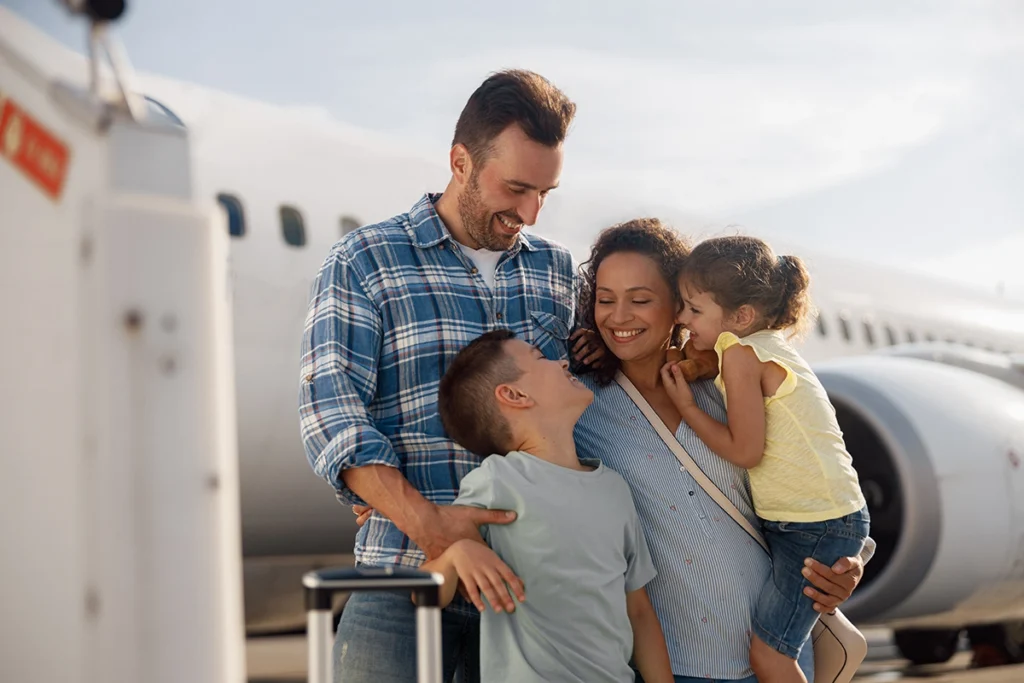
How to Prepare a Child for an International Trip
A child’s first trip to another country can be exciting, but it can also mean many unfamiliar situations happening at once.
A different language.
New food.
A hotel.
An airport.
A long journey.
An unfamiliar city.
A change in daily routine.
Adults usually know where they are going and roughly what to expect. A child may only hear:
“In two weeks, we’re going on holiday.”
The best way to prepare a child for an international trip is to show them where they are going, explain how the journey will work and describe what they can expect when they arrive. A map, a few pictures, a simple plan and conversation can make an unfamiliar situation feel more predictable.
You do not need to explain everything.
A few concrete pieces of information are usually more useful than a long presentation about the entire country.
When should you start preparing a child for an international trip?
Start early enough for the child to become familiar with the idea, but there is usually no need to begin months in advance. Information can be introduced gradually during the weeks before departure.
There is no single ideal time.
It depends on:
- the child’s age,
- the length of the journey,
- whether they have travelled before,
- the type of transport,
- how different the trip will be from everyday life.
A child who flies regularly may need only a short reminder.
A first international trip may require more preparation.
There is no need to explain the airport, plane, hotel, country, language, food and every attraction in one conversation.
Introduce these things gradually.
Where should you start when preparing a child for their first international trip?
The best first step is to show the child where they are going. Finding the country on a map creates a basic context for everything else.
Start with:
“This is where we live.”
Then:
“And this is where we’re going.”
If you are travelling from Poland to Spain, find both countries.
Ask:
“Are they close to each other?”
“What is between them?”
“Are we driving or flying?”
Older children can try to find the destination themselves.
For younger children, simply showing the two locations is enough.
You do not need to explain map scale or exact distances.
The key message is:
“This is the place we’re going to.”
Read also: “How to Teach Kids to Read a World Map: Fun Map Activities Without Memorising.”
What should you tell a child about the country before travelling?
A few pieces of information are enough: the country’s name, location, flag, destination city and one or two things the child may actually see there.
For example, before a trip to Spain:
- country: Spain,
- continent: Europe,
- city: Málaga,
- language: Spanish,
- flag: red-yellow-red.
You can add one landmark or interesting fact.
That is enough to begin.
There is no need to teach the history of Spain or ask the child to memorise its regions.
The main purpose of pre-trip knowledge is to help the child recognise the place once they arrive.
Should you show children photos before travelling?
Yes. Pictures of the hotel, city, beach, streets and transport can help children form an initial idea of what they are going to see.
You do not need to show every attraction.
A few concrete images are enough:
“This is where we’ll sleep.”
“This is the beach.”
“This is what the airport looks like.”
“This is one place we may visit.”
For a first trip, practical images may be more useful than famous landmarks.
The room.
The pool.
The airport.
The neighbourhood.
These may matter more to the child than the region’s most important monument.
Should children know the travel plan in advance?
Yes, but keep it simple. Children usually do not need a detailed hourly itinerary. They mainly need to know what will happen first, next and afterwards.
For example:
- we drive to the airport,
- we drop off the luggage,
- we go through security,
- we wait at the gate,
- we get on the plane,
- we fly,
- we collect our suitcase,
- we travel to the hotel.
For younger children, you can draw it:
🚗 → ✈️ → 🧳 → 🏨
A simple sequence answers an important question:
“What happens next?”
How can you prepare a child for the airport?
Before the first flight, briefly explain that an airport involves several stages: checking in or dropping off luggage, going through security, waiting at the gate and boarding the plane.
You do not need to explain every procedure.
The child mainly needs to know that:
- airports can be busy,
- there may be waiting,
- checked luggage may travel separately,
- you will go through security,
- you may wait before boarding.
You can show them a photograph of an airport terminal.
Or recreate the sequence during play.
A teddy bear can be the passenger.
A backpack can be the suitcase.
Chairs can become the plane.
The aim is not realism.
It is understanding the order of events.
How can you prepare a child for their first flight?
Explain what take-off, the flight and landing may feel like, and mention that pressure changes can make their ears feel blocked.
You might say:
“The plane will move faster and faster.”
“Then it will lift into the air.”
“Your ears may feel a little blocked.”
“After that, we’ll mostly sit while the plane flies.”
Avoid unnecessarily creating anxiety with statements such as:
“Don’t be scared, there’s nothing to worry about.”
If the child was not worried before, that wording can suggest that there is something to fear.
It is usually better to describe what will happen.
A full guide to a child’s first flight should be treated as a separate topic because it has its own search intent.
How can you prepare a child for a long journey?
Let the child know that the journey will take longer than an ordinary car ride and that some parts will involve waiting. Prepare several activities in advance.
For a younger child, an exact duration may mean very little.
Instead of:
“The flight is 3 hours and 45 minutes,”
say:
“It will take longer than the drive to Grandma’s.”
Or:
“We’ll have a snack, play for a while and then we’ll still have some flying left.”
Older children can follow the time and route more precisely.
How can you prepare a child for another language?
Explain that people at the destination may speak a language the child does not understand. Learning a few simple words together can make the situation more familiar.
Useful words include:
- hello,
- thank you,
- please,
- goodbye.
For Spain:
hola, gracias.
For Italy:
ciao, grazie.
You can also say:
“You don’t need to understand everything. We won’t know every word either.”
It can be reassuring for children to know that adults also sometimes need help understanding another language.
How can you prepare children for different food?
Explain that some food may look or taste different from what they know at home, but do not make trying local dishes compulsory.
Before travelling, you can look at a few foods associated with the destination.
But avoid:
“You have to try this when we’re there.”
Try:
“Let’s see if we can find this.”
If the child relies on familiar foods, include that in your planning too.
Trying new things should remain an opportunity, not a test of openness.
How can you prepare children for a hotel or unfamiliar accommodation?
Explain that you will sleep somewhere different for a few days and show photographs of the hotel or apartment if they are available.
For an adult, accommodation is a logistical detail.
For a child, it may mean:
- a different bed,
- unfamiliar sounds,
- different lighting,
- no usual bedroom,
- different breakfast routines.
You can say:
“This will be our room for a few days.”
If the child has a familiar small object, book or soft toy, bringing it can make the new environment feel more familiar.
Should children help pack?
Yes. Letting children choose a few things to bring can make the upcoming trip feel more concrete.
They do not need to decide what goes into the entire suitcase.
They can choose:
- a book,
- a toy,
- crayons,
- a soft toy,
- something for the journey.
Older children can use a simple list and prepare some of their own things.
A detailed packing checklist should be a separate article because it has a different search intent.
How can an educational activity book help before travelling?
A country activity book can help children form their first associations with the destination, particularly when it includes maps, flags, illustrations, facts and simple activities.
You do not need to complete the entire book before leaving.
Choose a few pages:
- where are we going?
- what does the flag look like?
- what place might we see?
- what animal, food or feature is connected with the country?
- one simple activity.
After the trip, you can return to the remaining pages.
The child can compare the educational material with their own experience.
Read also: “Countries of the World for Kids: How to Explore Cultures, Flags and Traditions.”
What should you do if a child is afraid of travelling?
First find out what they are actually worried about. “I don’t want to go” can mean fear of flying, anxiety about a new place, dislike of the long journey or simply not knowing what will happen.
Instead of:
“There’s nothing to be afraid of,”
ask:
“What worries you most?”
The answer may be very specific:
“I don’t know where we’ll sleep.”
“I’m worried I won’t understand people.”
“I don’t want my suitcase to disappear.”
Now you can respond to the actual concern.
If the fear is strong or persistent, it may need more individual support than ordinary travel preparation.
What if the child does not want to go?
A lack of excitement does not automatically mean there is a problem. The child may not understand what the trip will be like or may simply prefer familiar routines.
Avoid:
“You should be excited.”
Try:
“I know it will be something new. Let’s look at what it will be like.”
Then move to concrete questions:
Where are we going?
Where will we sleep?
What are we taking?
What will the child be able to do?
Sometimes interest appears only once the journey begins.
How can you prepare a child for an international trip step by step?
Prepare the child gradually: first introduce the destination, then explain the journey itself, and finally describe the first hours after arrival. This makes the whole experience easier to understand.
A few short activities spread across the days before travelling are enough.
1. Make a simple countdown calendar
A countdown helps children understand when the trip will happen and how much time is left.
You can use:
- paper squares,
- stickers,
- a simple row of days,
- boxes to cross off.
Each day, mark one.
“Five days left.”
“Two days.”
“Tomorrow.”
For younger children, this may be easier to understand than a calendar date.
Is it useful to practise the journey at home?
Yes. Acting out the sequence can help children understand what will happen, especially before a first flight.
Play through:
- packing,
- travelling to the airport,
- dropping off the suitcase,
- going through security,
- waiting at the gate,
- boarding,
- flying,
- collecting luggage,
- travelling to the hotel.
The child does not need a realistic simulation.
The key thing is sequence.
2. Create a visual travel plan
A simple visual plan might look like:
🏠 home
↓
🚗 journey
↓
✈️ plane
↓
🧳 luggage
↓
🚕 transfer
↓
🏨 hotel
Older children can use words instead of pictures.
Exact times are not necessary.
How can you prepare a child for airport security?
Explain that some belongings will briefly go through a scanner and that they may need to put down their backpack or jacket for a moment.
You can say:
“Your backpack will go through a special machine, and you’ll get it back on the other side.”
Also:
“The airport staff will tell us what to do next.”
The aim is to remove the surprise.
How can you prepare children for waiting?
Explain that travel includes periods when nothing much happens.
At an airport, you may wait:
- before check-in,
- at the gate,
- before take-off,
- for luggage,
- for transport.
Simply saying:
“There will be some walking and some waiting,”
creates realistic expectations.
3. Prepare activities for the journey
Choose a few things the child can do during quieter parts of the trip.
For example:
- a book,
- crayons,
- coloring pages,
- stickers,
- a small game,
- cards,
- an audiobook,
- one favourite toy.
Three or four good options are usually better than packing a large number of activities.
Do not introduce everything at once.
Should a child have their own backpack?
Yes, if they can comfortably carry one. A small personal backpack can give them a sense of involvement.
It might contain:
- a book,
- soft toy,
- headphones,
- crayons,
- a small snack,
- one toy.
Keep it light.
The point is not to transfer adult luggage to the child.
It is:
“These are my things for the journey.”
How can children take part in packing?
Let them choose:
“One book.”
“One soft toy.”
“Crayons or markers?”
Older children can use a short checklist.
Parents can still check everything afterwards.
4. Create a travel mission
One simple mission can give the child something to look for during the journey.
At the airport:
“Find three aeroplanes.”
“Look for the flag of the country we’re visiting.”
“Find our gate number.”
After arrival:
“Can you find something from the picture we looked at?”
“Find a sign in the local language.”
“Look for the flag.”
The mission should remain optional.
Should children follow the travel route?
Older children can follow the route on a map and see how their location changes during the journey.
Before leaving:
Poland → Spain.
After landing:
“We’re here now.”
If the aircraft has a route map, you can occasionally check where you are.
This helps connect travel with geography.
What should you do on the first day after arrival?
If possible, leave some time for the child to become familiar with the new environment rather than immediately following an intensive sightseeing schedule.
After travelling, children may be:
- tired,
- hungry,
- overstimulated,
- excited,
- irritable.
A simple first day can include:
- seeing the room,
- unpacking the essentials,
- eating,
- taking a short walk,
- finding the pool or beach.
There is no need to maximise every hour.
How can children settle into a new room?
Explore the accommodation together and show where the important things are.
“This is where we sleep.”
“Here is the bathroom.”
“This is where we put our clothes.”
“Your soft toy can stay here.”
Small familiar details can make a new place feel more predictable.
Should you maintain the child’s usual routine?
Keeping a few familiar routines can help, although the whole day does not need to look exactly like it does at home.
Useful familiar elements might include:
- a similar bedtime,
- a bedtime story,
- a favourite soft toy,
- quiet time after lunch.
Travel naturally changes routines.
The goal is not to reproduce home perfectly.
A few familiar points are usually enough.
How can you prepare a child for changes to the plan?
Explain in advance that travel plans sometimes change and that this does not mean the trip has gone wrong.
For example:
“We have a plan, but if it rains, we may do something different.”
Or:
“We might have to wait sometimes.”
You do not need to predict every possible problem.
The aim is simply to make flexibility part of the expectation.
What if a flight or journey is delayed?
Tell the child simply what has changed and what happens next.
Instead of:
“This is a disaster, we’re delayed by two hours,”
say:
“The plane will leave later. We’re going to wait here a bit longer.”
Older children can see the new departure time.
For younger children:
“First we wait, then we fly.”
Passenger rights and delay procedures should be covered in a separate, regularly updated guide.
How can children be prepared for crowds and noise?
Tell them that airports, stations and popular attractions may be noisy and busy. Knowing this in advance reduces surprise.
You might say:
“There will be lots of people and announcements at the airport.”
“We’ll stay together.”
“If you need something, tell me.”
The aim is to describe the environment realistically, not make it sound dangerous.
Should you set rules before travelling?
Yes, but keep them limited to a few practical safety rules.
For example:
- stay close at the airport,
- tell an adult before going anywhere,
- do not leave your backpack behind,
- stop together before crossing a road.
A short set of rules is easier to remember.
How can you prepare children for different customs?
Explain that some everyday things may work differently from home and describe differences without calling them strange or wrong.
This may involve:
- meal times,
- transport,
- language,
- shops,
- eating customs,
- opening hours.
Try:
“Let’s see what is different here.”
The child becomes an observer rather than a judge.
Can preparing for a trip also be educational?
Yes. Preparation naturally connects maps, geography, language and culture, but it should not become extra homework before a holiday.
A child can:
- find the country,
- color the flag,
- learn two words,
- see one landmark,
- read one fun fact.
That is enough.
If they want more, continue.
If not, more information can wait until the trip.
Do you need to prepare a child for everything?
No. The goal is not to remove every surprise. It is to make the most unfamiliar parts more understandable.
Focus on:
- destination,
- transport,
- accommodation,
- basic sequence,
- a few obvious differences.
Leave the rest to discovery.
What should you avoid just before departure?
Do not overload the child with large amounts of new information, warnings and rules on the day before travelling.
Avoid suddenly explaining:
- every possible problem,
- the entire history of the country,
- a long list of rules,
- every day’s detailed itinerary.
Instead:
“Tomorrow we leave.”
“First the airport.”
“Then the plane.”
“By the evening, we’ll be at the hotel.”
Simple and clear.
A simple timeline for preparing a child for travel
A few weeks before
- show the country on a map,
- explain how you will travel,
- look at a few photographs.
A few days before
- review the journey sequence,
- prepare the child’s backpack,
- learn a few words,
- choose one attraction.
The day before
- remind the child of the simple plan,
- prepare travel activities,
- check what they are taking.
On the travel day
- explain only what happens next,
- avoid describing every later stage at once,
- leave space for rest and observation.
How can you prepare children for the first few days abroad?
Preparation continues after arrival. The first days can be used to become familiar with the new environment, language and daily rhythm.
Children are taking in:
- accommodation,
- sounds,
- food,
- weather,
- transport,
- another language.
For adults, these may feel like background details.
For children, they may be part of the adventure.
Should the first day abroad be less intensive?
If possible, keep the first day relatively flexible so the child has time to recover from the journey and explore the immediate surroundings.
You can:
- walk around the neighbourhood,
- find the beach,
- visit the town centre,
- get something to eat,
- find a park.
The first mission can simply be:
“Let’s see where we are.”
How can a child become familiar with the new area?
Show them several easy-to-recognise landmarks near the accommodation.
For example:
“This is our hotel.”
“We walk this way to the beach.”
“We turn at this fountain.”
Older children can view the neighbourhood on a map.
The aim is not independent navigation.
It is simply:
“I roughly know where I am.”
How should you use maps during the trip?
Use a map when it answers a real question rather than turning it into a compulsory activity.
For example:
“Where is our town?”
“How far are we from the sea?”
“Where did we go yesterday?”
“Where are we going today?”
Maps should support the journey, not interrupt it.
How can you help a child notice the new environment?
Start with things the child notices themselves. Their own observations are often the best starting points for learning.
“The trees look different.”
“Why is everyone speaking differently?”
“The buses look different here.”
These comments naturally lead to conversations about:
- plants,
- languages,
- transport,
- local life.
You do not need to create educational questions all day.
Sometimes it is enough to listen.
How can you encourage observation without turning it into a quiz?
Try:
“What looks different from home?”
“Can you see any flags?”
“What signs can you find?”
“Which building do you like most?”
“What kinds of vehicles are here?”
One question is enough.
Should children use activity books during the trip?
They can, but only if they want to. Educational materials should support the real experience rather than compete with it.
Before going out:
“Today we’re going to see the place from this page.”
In the evening:
“Remember? We saw this today.”
You can use the book:
- before sightseeing,
- during a rest,
- in the evening,
- after returning home.
The most valuable connection is:
information → real experience.
How can children notice the local language?
Use naturally occurring words on signs, in shops, restaurants and greetings.
“You heard gracias.”
“Look, this sign says hola.”
Children do not need to speak the language.
Simply noticing that different words can have the same meaning is already useful.
What if a child refuses local food?
Do not turn eating into a test of courage or cultural openness. Offer new foods, but do not make them compulsory.
Instead of:
“We’re in Spain, so you have to try this,”
try:
“Would you like to see what it tastes like?”
If the answer is no, leave it.
Markets, bakeries and menus can still be interesting even without tasting everything.
How should you talk about cultural differences?
Describe differences as observations rather than judgements. Different does not mean strange or wrong.
If a child asks:
“Why do people eat so late here?”
say:
“Meal times can be different in different countries.”
This avoids teaching:
ours = normal, theirs = strange.
What if a child misses home?
Missing home can happen even when the child was excited before travelling. Let them talk about what they miss rather than insisting that they should be enjoying the holiday.
Ask:
“What do you miss most?”
It might be:
- their bed,
- a pet,
- grandparents,
- a friend,
- an ordinary routine.
Familiar routines and objects can help.
Missing home does not mean the trip was a mistake.
What if the child is tired of sightseeing?
Treat tiredness as information, not as a lack of curiosity. A child can be interested in the world and still have no energy for another attraction.
A long day may include:
- walking,
- heat,
- crowds,
- noise,
- unfamiliar surroundings.
Skipping one attraction can sometimes improve the rest of the day.
Travel is not a competition to see the maximum number of places.
Does a child need to visit every attraction with the adults?
No. A family plan should include the interests and need for rest of all participants.
If adults want to visit a museum, later the plan might include:
- a park,
- beach,
- playground,
- ice cream,
- something the child chose.
This is not a reward for enduring the museum.
It is simply balance.
What should you do when travel plans change?
Tell the child briefly what has changed, why, and what the new plan is.
“We were going to the beach, but it’s raining. Today we’ll visit the museum, and we’ll try the beach tomorrow.”
That is usually enough.
How can travel support learning without becoming a lesson?
The best learning happens when information helps explain something the child has just experienced.
The child sees the sea
→ find its name.
They see a flag
→ connect it with the country.
They hear a word
→ check what it means.
They see mountains
→ find them on a map.
They notice an animal
→ discover where else it lives.
There is no need for a test back at the hotel.
What should you do after returning from an international trip?
Return to maps, photographs and the materials you used before travelling so the child can connect expectations with real experience.
Ask:
“Can you find where we were?”
“What surprised you most?”
“What was different from what you expected?”
“What would you like to see again?”
You do not need to do this immediately after coming home.
How can you create a memory map?
A memory map combines geography with the child’s personal experiences.
Mark:
- the country,
- the city,
- the route,
- one favourite place.
Add:
- a photograph,
- sticker,
- flag,
- drawing.
Over time, the map becomes a record of family journeys.
How can children create a “My Trip” page?
One sheet of paper is enough.
MY TRIP TO SPAIN
I visited:
…
My favourite thing was:
…
The biggest surprise was:
…
A new word:
…
I want to remember:
…
My drawing:
…
Younger children can draw.
Older children can write.
Should you return to a country activity book after the trip?
Yes. The same material may become much more meaningful after the child has visited some of the places or seen the symbols in real life.
Before the trip:
“This is a landmark.”
After the trip:
“We were there.”
Before:
“This is the flag.”
After:
“We saw it at the airport.”
An activity book can therefore be used:
before → during → after the journey.
How can photographs support learning after the trip?
Let the child choose the photographs that best represent their own experience.
Ask:
“Which photo do you want to keep?”
“Why this one?”
“What was happening here?”
The most important picture may be a cat, ice cream, the pool or an aeroplane rather than a famous landmark.
That is fine.
How can knowledge from a trip be reinforced naturally?
Revisit information when it appears again in everyday life rather than organising a formal review session.
Weeks later, you see the Spanish flag.
“Do you remember this one?”
A book mentions Málaga.
“We were there.”
You hear Spanish.
“That sounds like the language we heard on holiday.”
The information becomes part of a network of real memories.
Should children explore neighbouring countries after a trip?
Yes, if they are interested. A visited country can become a starting point for exploring the wider region.
After Spain:
“Which countries are next to Spain?”
After Japan:
“What other countries are in this part of Asia?”
After the USA:
“Which countries border the United States?”
Personal experience can gradually expand into broader geography.
What mistakes should you avoid when preparing a child for international travel?
Common mistakes include overwhelming the child with information, creating unnecessary anxiety, expecting visible excitement and planning everything only from the adults’ perspective.
Avoid:
- warning about every possible problem,
- repeatedly saying “don’t be scared”,
- discussing every detail of every day,
- expecting the child to love every attraction,
- forcing local foods,
- testing knowledge while sightseeing,
- overcrowding the itinerary,
- ignoring the need for rest,
- calling other customs strange.
Preparation should make the trip more predictable.
It should not create more things for the child to worry about.
Checklist: how to prepare a child for an international trip
Good preparation does not require an elaborate programme. Introduce the most important parts of the journey and leave room for discovery.
- Show the destination on a map.
- Explain how you will travel.
- Show a few pictures of the destination and accommodation.
- Explain the basic journey sequence.
- Mention that another language may be spoken.
- Learn a few simple words together.
- Let the child choose a few items for their own backpack.
- Prepare several activities for the journey.
- Mention waiting, crowds and changes to routine.
- Leave some space for a calm arrival.
- Give the child small choices.
- Return to the map and memories after coming home.
The first international trip may need more preparation than later ones.
Frequently Asked Questions
How can I prepare my child for their first international trip?
Start by showing the destination on a map, explain how you will get there and show where you will stay. Then gradually introduce the language, country and basic sequence of the journey.
How early should I tell my child about the trip?
There is no single correct number of days. Give the child enough time to become familiar with the idea and introduce information gradually rather than all at once immediately before departure.
How can I prepare my child for their first flight?
Explain what happens at the airport and what take-off, the flight and landing may feel like. Mention waiting, noise and the possibility of blocked ears. A detailed guide to the first flight is best treated as a separate topic.
What should I tell my child before visiting another country?
The basics are enough: where the country is, how you will travel, where you will stay, what language is spoken and a few things you are likely to see.
Should I show my child the hotel before travelling?
Yes. Pictures of the room, building and surroundings can help the child imagine where they will be staying.
What if my child is afraid of travelling?
Ask what they are specifically afraid of before trying to reassure them. A specific concern is easier to address than a general statement such as “there’s nothing to worry about”.
How can I prepare my child for a foreign language?
Explain that people may speak differently and that the child does not need to understand everything. Learn a few simple words together.
Should my child have their own backpack?
They can, as long as it is small and light enough to carry comfortably. Let them choose a few personal items.
How can I keep my child occupied during a long journey?
Prepare several different activities and introduce them gradually. Books, coloring pages, stickers, audiobooks, small games and a favourite toy can all work.
Should children learn about a country before visiting?
Yes, but it does not need to become a full lesson. A map, flag, a few photos, one landmark and one fun fact are enough to create useful first associations.
What should we do on the first day after arrival?
If possible, allow time for rest and exploring the immediate surroundings rather than beginning with an intensive sightseeing schedule.
How can travel become educational?
Connect knowledge with what the child is actually experiencing. Find the location on a map, notice flags and languages and answer questions that arise naturally during the journey.
Summary
Preparing a child for international travel does not mean explaining everything that could happen during the holiday.
The goal is to answer a few basic questions:
Where are we going?
How will we get there?
Where will we sleep?
What will be different from home?
What happens first, and what happens next?
A map gives the journey a destination.
Pictures make the place easier to imagine.
A simple plan makes the route more predictable.
A few words make another language feel less unfamiliar.
Familiar objects can make a new environment easier to settle into.
And then comes the part that does not need to be completely planned:
discovery.
A child does not need to know every attraction, fact and custom before leaving.
It is enough for the destination to stop feeling completely unknown.
Everything else can be discovered along the way.
Start the journey before you pack the suitcase.
Our educational country activity books combine maps, child-friendly facts, illustrations, coloring and activities. They can help children become familiar with a destination before a family trip, revisit selected pages while travelling and connect what they learned with what they actually experienced after returning home.