
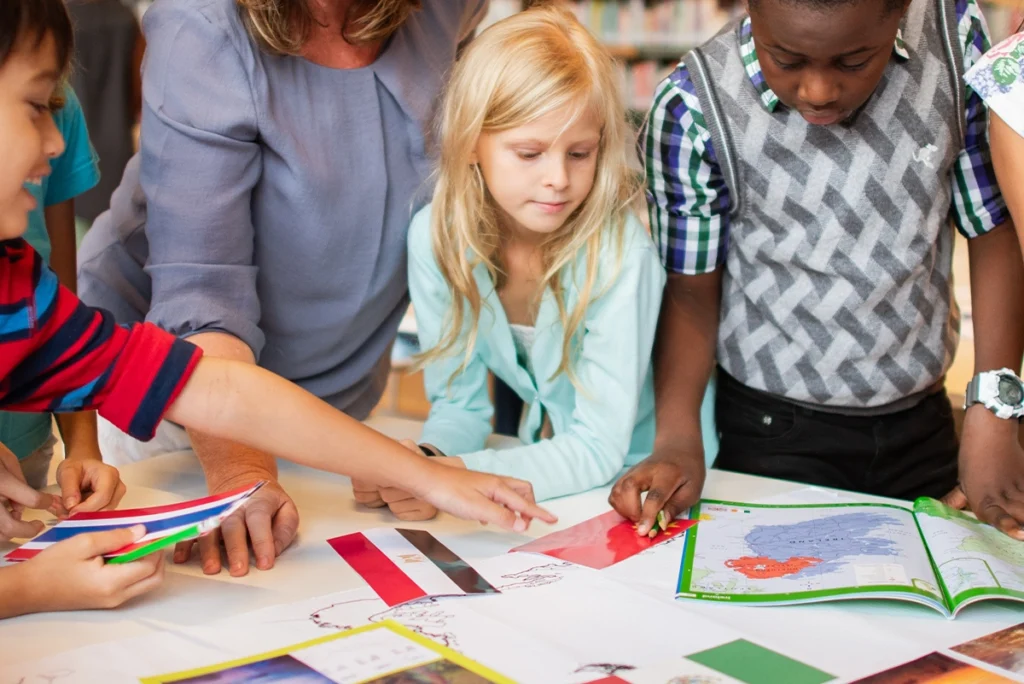
Flags of the World for Kids – How to Learn Them Through Play
Flags are some of the most recognisable symbols of countries. They are colorful, usually based on relatively simple shapes and patterns, and can quickly catch a child’s attention.
After the first few examples, however, things can become more difficult.
Red, white and blue appear on many flags. Some flags differ only in the order of their colors. Others use similar crosses, stars or stripes.
That is why showing a child dozens of flags on one poster and trying to memorise them all is rarely the best place to start.
The best way for children to learn country flags is gradually, connecting each flag with the name of the country, its location on a map and one or two distinctive features. Matching games, memory games, coloring and comparisons help children notice details instead of simply memorising pictures.
A flag then becomes more than a pattern.
It represents a real country.
And from that country, children can move on to maps, languages, capitals, wildlife, landmarks and cultures.
How many flags should a child start with?
It is better to begin with a small number of clearly different flags than to introduce dozens of countries at once. Around four to six flags can provide plenty of opportunities for games without overwhelming the child.
A good starting point can include countries the child already knows.
For example:
-
Poland,
-
Japan,
-
Italy,
-
France,
-
the United States.
This does not need to be the exact set.
If your child has visited Spain, include Spain.
If they are interested in the United Kingdom, add its flag.
If you are currently exploring Australia together, include Australia.
New flags work particularly well when they appear in a meaningful context, rather than simply because they are next on a list.
Once the first few become familiar, add another two or three.
The collection can gradually grow.
Should children memorise country flags?
Memory is naturally involved in learning flags, but rote memorisation does not need to be the starting point. Children can first learn to notice distinctive features and connect each flag with a specific country.
Take the flag of Japan.
A child can notice:
-
a white background,
-
a red circle,
-
a very simple design.
Then find Japan on a map.
This creates a connection:
flag → Japan → Asia.
With Italy, the child can notice:
-
three vertical stripes,
-
green,
-
white,
-
red.
Then compare the Italian flag with the French flag.
Both have three vertical stripes, but the colors are different.
The child is no longer simply trying to remember an image.
They are learning what makes one flag different from another.
Why should flags be connected with a map?
A flag becomes more meaningful when a child knows which country it represents and where that country is located. After introducing a new flag, it is therefore useful to find the corresponding country on a map.
Suppose the child is learning the flag of Brazil.
You can ask:
“Which country does this flag belong to?”
Then:
“Can we find Brazil on the map?”
“Which continent is it in?”
“Is it close to Poland?”
A few minutes are enough to connect the symbol with a real place.
Otherwise, a child may become very good at recognising Brazil’s flag without having any idea where Brazil actually is.
The goal does not need to be collecting pictures.
Flags can become one of the tools for exploring geography.
Read also: “How to Teach a Child the World Map Through Play.”
How can children learn to recognise flags?
A simple way to learn flag recognition is to focus on three features: colors, layout and distinctive symbols.
With every new flag, ask a few questions.
What colors can you see?
Let the child name them.
How are they arranged?
Look for:
-
vertical stripes,
-
horizontal stripes,
-
crosses,
-
circles,
-
stars,
-
other symbols.
What is the most distinctive feature?
For Japan, it may be the red circle.
For Canada, the maple leaf.
For Brazil, the distinctive central design on a green background.
For the United States, the stripes and the field of stars.
Only then move to:
“Which country does this flag belong to?”
The child observes first and names the country afterwards.
How can children learn similar-looking flags?
Similar flags are easier to learn when they are compared directly. Placing them next to each other helps children consciously identify the feature that distinguishes one from another.
Take:
France and Italy.
Both have three vertical stripes.
But:
France – blue, white, red.
Italy – green, white, red.
Ask:
“What changed?”
The same method can be used with flags that have horizontal stripes or similar symbols.
Children do not need to recognise every subtle difference immediately.
Comparison is precisely what helps them begin noticing those differences.
It is often easier to introduce a similar-looking flag after the child already knows one of the pair.
Should children learn the meaning of flag colors and symbols?
Yes, when the symbolism is well documented and can be explained accurately and simply. However, adults should avoid inventing meanings or assuming that every color has one simple explanation.
There are many oversimplified stories about national flags.
If you want to explain symbolism, use reliable information about that particular flag.
Younger children do not need the entire history.
One interesting fact may be enough.
A distinctive symbol can also become an additional clue for recognising the country.
Symbolism should remain an extra layer.
Start with:
appearance → country → location.
History and symbolism can come later.
Is sorting flags by color useful?
Yes. Sorting flags by shared features helps children notice patterns and differences. Flags can be grouped by colors, stripes, symbols, layout or geographical region.
Try:
“Find all the flags that contain red.”
“Which flags have three colors?”
“Find the flags with stars.”
“Which ones have vertical stripes?”
“Which ones have a cross?”
At this stage, the child does not even need to name every country.
They are practising careful observation.
Later you can add:
“Do you remember which countries these flags belong to?”
This creates a gradual progression from observation to recognition.
How can coloring help children learn flags?
Coloring flags can support learning when children need to study a correct reference and reproduce the colors and layout accurately. It becomes more useful when the activity is also connected with the country’s name and location on a map.
Prepare a black-and-white outline.
Give the child a correct reference.
First, they observe it.
Then they choose the colors.
Next, they reproduce the flag.
Finally, they find the country on the map.
This creates a simple sequence:
look → notice → color → name → find.
Accuracy matters more with flags than with ordinary creative coloring because the colors and layout are part of the national symbol.
Read also: “Educational Coloring Pages for Kids – How to Use Them for Learning.”
How can you make simple flag cards?
For the first games, simple cards with a flag on one side and the country’s name on the other are enough. They can be used for recognition, matching, sorting and quick quizzes.
There is no need to prepare every country in the world.
Start with a few cards.
Use them to:
-
identify a country from its flag,
-
find a flag after hearing a country’s name,
-
sort countries by continent,
-
group flags with similar colors,
-
find countries on a map.
One small set can therefore support many activities.
Whenever the child explores another country, add another card.
How can you make a flag memory game?
A flag memory game can use two identical flags or, in a more challenging version, pair each flag with the name of its country. The second version creates a stronger connection between the image and the information it represents.
For younger children, start with:
flag → identical flag.
Later use:
flag → country name.
Then try:
flag → country outline
or:
flag → famous landmark.
After finding a pair, the child can optionally locate the country on a map.
There is no need to do this after every turn if it interrupts the game.
The activity should still feel like a game.
How can quizzes be used to learn flags?
A flag quiz works best as a recognition game rather than an exam. Mix familiar flags with a few newer ones and allow children to use clues when needed.
The simplest question is:
“Which country does this flag belong to?”
But you can also ask:
“Which of these flags belongs to a country in Asia?”
“Find the flag of the country whose capital is Rome.”
“Which flag belongs to a country we have visited?”
“Which flag uses the same colors as France but arranges them differently?”
Now the child needs to use more than one association.
If they do not know the answer, let them use a map, cards or an activity book.
A quiz does not have to test memory alone.
It can also teach children how to find an answer.
How can flags introduce children to countries around the world?
A flag can be the starting point for exploring an entire country. Once the child recognises it, add one more piece of information: its location, capital, language, landmark or an interesting fact.
For example:
Italy → Europe → Rome → Colosseum.
For Japan:
Japan → Asia → Tokyo → Mount Fuji.
For France:
France → Europe → Paris → Eiffel Tower.
There is no need to create a full lesson about every country.
The important thing is that the flag does not remain an isolated image.
It should lead to a real place and several meaningful associations.
Read more: “Countries of the World for Kids – How to Explore Cultures, Flags and Traditions.”
Should children start with European flags?
They can, particularly if they live in Europe and already recognise several European countries. However, there is no need to learn every flag from one continent before exploring another.
Geographical proximity provides useful context.
You might begin with:
-
Poland,
-
Germany,
-
the Czech Republic,
-
Italy,
-
France,
-
Spain.
But if the child is fascinated by Japan or Australia, there is no reason to postpone those countries until every European flag has been learned.
Learning does not need to follow a rigid continental order.
How can travel and sports help children learn flags?
Real-world situations provide natural opportunities for flag recognition. Travel, international sports and other events show children that national flags exist outside educational materials.
Before a trip, look at the destination country’s flag.
During a sporting event, ask:
“Which countries are playing?”
“Do you recognise either flag?”
If an unfamiliar one appears:
“Let’s find out which country it belongs to.”
This gives flags a purpose.
They are no longer only pictures on cards.
They become symbols that children encounter in the real world.
How many flags should a child know?
There is no specific number of flags that every child should know at a particular age. Gradually expanding their knowledge and connecting symbols with real countries is more important than reaching a target number.
One child may become fascinated with flags and quickly learn dozens.
Another may remember only the countries that particularly interest them.
Both are fine.
Instead of asking:
“How many flags do you know?”
try:
“What do you know about the country whose flag you just recognised?”
The symbol then becomes the beginning of broader knowledge.
10 fun flag activities for kids
The best flag activities encourage children to recognise, compare, match and search for information. A small set of familiar flags can be reused in many different ways simply by changing the rules.
1. Match the flag to the country
Prepare two sets of cards:
-
flags,
-
country names.
Start with four pairs.
The child matches each flag with the correct country.
If they do not know an answer, allow them to use a map, book or another reference.
The activity does not need to be a test.
It can be:
“Find the information and make the correct match.”
2. Match the flag to the map
The child chooses a flag and then:
-
identifies the country,
-
finds it on the map,
-
names the continent.
Older children can also find the capital or neighbouring countries.
The key connection remains:
flag → country → map.
3. Play flag memory
Use identical pairs for beginners.
Later try:
flag → country name
or:
flag → country outline.
The same familiar game can gradually become more challenging.
4. Play “Flag Detective”
Flag Detective encourages children to identify a country from a description of its flag.
For example:
I have a white background and a red circle in the middle.
Which flag am I?
Or:
I have three vertical stripes: green, white and red.
Older children can receive less obvious clues.
Children can also describe a flag themselves while the adult guesses.
5. Find the odd one out
One flag does not belong with the others according to a particular rule. The child has to discover what connects the rest of the group.
For example:
France, Italy, Belgium and Poland.
The first three have vertical stripes.
Poland has horizontal stripes.
Another group might contain three European countries and one Asian country.
Possible rules can involve:
-
colors,
-
layout,
-
symbols,
-
continents,
-
shared visual features.
Does sorting flags help children learn?
Yes. Sorting requires children to identify a shared feature and helps them notice patterns that are less obvious when flags are viewed individually.
Ask:
“Find every flag with red.”
Then:
“Which ones have three colors?”
Or:
“Which ones contain stars?”
Possible categories include:
-
vertical stripes,
-
horizontal stripes,
-
crosses,
-
stars,
-
circles,
-
European countries,
-
Asian countries.
Some flags may fit more than one category.
That can become part of the discussion.
6. Play flag bingo
Flag bingo allows children to review several countries at once without being questioned about every flag individually.
Place several flags on a bingo board.
Instead of naming the country, give a clue:
“A country whose capital is Rome.”
The child marks Italy.
Or:
“An Asian country with a white flag and a red circle.”
The child marks Japan.
Clues can refer to:
-
capitals,
-
continents,
-
locations,
-
landmarks.
This connects flag recognition with wider knowledge about countries.
7. Play “Which flag is missing?”
Place five flags on the table.
Let the child look at them.
Then they close their eyes.
Remove one card.
Ask:
“Which flag is missing?”
The child may initially describe it:
“The one with the red circle.”
Then connect it with the name:
“Yes, Japan is missing.”
Later, remove two cards to increase the difficulty.
8. Try a reverse flag quiz
Instead of showing a flag and asking for the country, name the country and ask the child to find its flag.
For example:
“Find Spain.”
Or:
“Find the flag of the country whose capital is Paris.”
Changing the direction of the task encourages children to retrieve information in another way.
9. Create a flag passport
An explorer passport can collect the flags and basic information about countries the child has already discovered.
Each country can have one page:
JAPAN
Flag: [space for drawing]
Continent: Asia
Capital: Tokyo
I remember: ___________
The child can:
-
draw the flag,
-
color it,
-
add a sticker,
-
write one fact.
The passport can grow gradually.
10. Let children create their own flag cards
The child:
-
chooses a country,
-
finds an accurate flag reference,
-
checks the colors,
-
observes the layout,
-
draws or colors the flag,
-
writes the country’s name on the back.
The finished cards can later be used for:
-
memory games,
-
quizzes,
-
bingo,
-
sorting,
-
map activities.
Creating the cards becomes part of the learning process.
How can flags help children learn the continents?
Sorting flags by continent allows children to practise both flag recognition and geographical location.
Create areas for:
Europe
Asia
Africa
North America
South America
The child draws a flag and tries to place it in the correct group.
If they do not know, use the map.
Instead of:
“You should know Japan is in Asia,”
try:
“We’re not sure. Let’s check.”
The map becomes a tool for solving the problem.
How can children practise similar flags?
When a child confuses two flags, place them side by side and identify one specific feature that distinguishes them.
For France and Italy:
Both have:
-
three vertical stripes,
-
white in the middle,
-
red on the right.
The difference is the first color:
France – blue.
Italy – green.
The child now has a concrete feature to check.
Other differences may involve:
-
stripe order,
-
symbols,
-
direction,
-
number of elements,
-
proportions.
The goal is not simply to say:
“Remember this one.”
It is to show what to look for.
Are visual associations useful for learning flags?
Associations can help when they refer to a real visual feature and do not introduce false information about the country.
A child might say:
“Japan has a big red circle.”
That becomes a simple visual clue.
They may create their own way of remembering the first color in the French and Italian flags.
There is no need to invent a story for every flag.
The association should make recognition easier, not become more difficult to remember than the flag itself.
How should new flags be introduced?
Add new flags in small groups and mix them with symbols the child already knows. This creates natural repetition while gradually expanding the set.
Suppose the child already recognises:
Poland, Japan, Italy and France.
Add:
Spain and Germany.
After several games, add another two.
There is no need to wait for perfect accuracy.
Mistakes are normal.
However, placing dozens of unfamiliar flags in front of a beginner usually turns observation into guessing.
How can flags be reviewed without constant testing?
The same flag can reappear in different contexts: maps, bingo, coloring, travel, sports, matching games and country activity books.
Japan’s flag might appear:
-
in memory,
-
while exploring Asia,
-
on a coloring page,
-
during a map activity,
-
in an activity book about Japan,
-
during an international sporting event.
The child encounters the same symbol repeatedly without doing the same exercise every time.
How can educational country books use flags?
A flag can be one of the first elements used to introduce a country. It can then be connected with the map, capital, landmarks and activities.
A simple sequence might be:
-
look at the flag,
-
identify the country,
-
color the flag,
-
find the country on a map,
-
discover the capital,
-
explore additional facts.
The child does not learn flags as a disconnected collection of symbols.
Each one becomes an entry point into a real place.
How should flag activities be adapted to age?
Flag activities should match the child’s abilities and interests rather than follow a strict age requirement. Younger children can recognise a few clearly different flags, while older children can connect them with countries, continents, capitals and maps.
A general progression might look like this:
| Stage | Example activities |
|---|---|
| First activities | 3–5 different flags, colors, simple matching |
| Recognition | flag → country, memory, coloring from a reference |
| Connecting information | flag → country → continent |
| More independence | flag → country → map → capital |
| Advanced play | similar flags, quizzes, sorting, independent research |
The goal is not to complete every flag in the world.
How can younger children learn flags?
Younger children can begin with a few flags that look clearly different from one another. Recognising colors and distinctive features can come before memorising many country names.
For example:
-
Poland,
-
Japan,
-
Canada,
-
Brazil.
Ask:
“Where is the red circle?”
“Which flag has a leaf?”
“Can you find the red-and-white flag?”
Then gradually introduce the country names.
How can older children learn flags?
Older children can connect each flag with a wider geographical context, including the country, continent, capital and location on a map.
Instead of only asking:
“Which flag is this?”
try:
“Which country does it belong to?”
“Which continent is it on?”
“Can you find it on the map?”
“What is its capital?”
“Which other flag looks similar?”
Older children can also use an atlas or other resources independently.
They do not need to know every answer immediately.
Knowing how to find the answer is useful too.
Do children need to learn flags continent by continent?
No. Learning by continent can organise information, but children can also explore countries connected with their interests, travels or current activities.
Later, known flags can be sorted:
“Which of these countries are in Europe?”
“Which are in Asia?”
“Have we discovered any countries in North America?”
The continents then help organise knowledge that is already developing.
Should children know every flag in the world?
No. There is no educational requirement for every child to recognise every national flag. Understanding that a flag represents a country and connecting some flags with geography is more important than reaching a particular number.
A child who loves flags may naturally learn dozens or even more.
That interest can be encouraged.
But there is no universal target such as:
“A child of this age should know X flags.”
What should you do when a child keeps confusing flags?
Instead of repeating the country names, compare the flags side by side and identify one specific difference.
Ask:
“What is the same?”
Then:
“What is different?”
Give the child a concrete strategy.
For France and Italy:
“Check the first stripe.”
This is more useful than saying:
“You need to remember it better.”
What are the most common mistakes when teaching flags?
The most common mistakes are introducing too many flags at once, teaching symbols without geographical context, constantly testing the child and expecting perfect recognition of similar flags immediately.
Avoid:
-
dozens of new flags at once,
-
learning flags without countries or maps,
-
turning every activity into a quiz,
-
correcting every mistake immediately,
-
focusing only on the visual symbol.
If the goal is to explore the world, keep returning to:
flag → country → map.
How can you tell whether a child really recognises a flag?
Use the information in both directions. Do not only show a flag and ask for the country’s name. Name a country and ask the child to find its flag.
Then try:
“Can you find this country on the map?”
Or:
“Which of these flags belongs to a country in Asia?”
This checks several connections:
image → country
country → image
image → country → location.
Should a flag quiz use points?
It can, but points are optional. They work best when they support the game rather than becoming more important than discovering the countries themselves.
For example:
1 point for recognising the flag,
1 point for finding the country,
1 bonus point for sharing a fact.
Or work together:
“Can we collect 15 points as a team?”
You can also skip points entirely and move an explorer token across a map after each recognised flag.
Are flag-learning apps useful?
Flag apps can be useful for quick recognition practice, particularly when they offer short quizzes and gradual difficulty. They do not need to replace maps, conversations or hands-on activities.
Different tools support different actions.
An app offers quick recognition.
A map shows location.
Cards can be sorted.
Coloring requires reproducing a pattern.
There is no need to choose exclusively between digital and paper-based learning.
Do flag coloring pages help children learn?
They can, particularly when children use an accurate reference, reproduce the colors correctly and connect the finished flag with the country and its location.
A simple sequence works well:
-
look,
-
choose the colors,
-
reproduce the layout,
-
name the country,
-
find it on a map.
The goal is not simply to fill in an outline.
It is to observe the national symbol carefully.
How can you move from a flag to learning about a whole country?
After recognising a flag, add one or two pieces of information about the country. The flag can then become the beginning of a broader exploration.
Use:
flag → country → map → one interesting fact.
For example:
Japan
Flag: white background with a red circle.
Location: Asia.
Next connection: Tokyo or Mount Fuji.
There is no need to introduce the capital, language, currency, history, food and every major landmark in one session.
Those topics can be explored gradually.
How can flags be used before travelling with children?
Before a trip, show the child the destination country’s flag and locate the country on a map. This gives the symbol an immediate real-world connection.
Before leaving:
-
find the country,
-
look at the flag,
-
color it,
-
discover the capital,
-
look at a few places you may see.
During the trip:
“Can you spot the flag we colored?”
After returning, add it to a travel journal or explorer passport.
The flag now connects with a personal experience.
Should children learn flag symbolism?
Flag symbolism can be introduced as an additional fact when the information is accurate, well documented and appropriate for the child’s age. It is not necessary for the first stage of flag recognition.
A useful order is:
what it looks like → which country it represents → where the country is → why the flag looks that way.
History and symbolism can become a separate topic for children who develop a deeper interest.
10 rules for learning country flags through play
Country flags are easiest to learn gradually, with regular review and strong connections between the symbol, the country and its location.
-
Start with a small number of flags.
-
Choose clearly different designs first.
-
Connect every flag with a country name.
-
Find the country on a map.
-
Compare similar flags side by side.
-
Use memory games, quizzes and matching activities.
-
Let children search for answers.
-
Review flags through different activities.
-
Add new countries gradually.
-
Treat the flag as the beginning of exploring a country, not the final goal.
Frequently Asked Questions
How can I teach my child country flags?
Start with a few clearly different flags and connect each one with the country’s name and location on a map. Then use matching games, memory, coloring, quizzes and riddles to revisit them in different ways.
How many flags should we start with?
Around four to six is enough for the first activities. Add more gradually as the first set becomes familiar.
Should children know all the flags in the world?
No. There is no specific number every child needs to know. Connecting flags with real countries and geographical locations is more important than memorising a large collection.
How can children learn similar-looking flags?
Place the flags next to each other and identify one specific difference, such as the first color, stripe order, symbol or layout.
Does coloring help children remember flags?
It can. Coloring requires children to observe the colors and layout carefully. It works best when combined with the country’s name and location on a map.
What games are good for learning flags?
Memory, bingo, matching, Flag Detective, odd-one-out games, reverse quizzes, sorting and “Which flag is missing?” are all useful options.
Should flags and capitals be learned together?
They can be, especially for older children, but there is no need to introduce everything at once. Start with flag and country, then gradually add the map and capital.
Is it better to learn flags by continent?
It can help organise knowledge, but it is not necessary. Children can also begin with countries connected with their interests, travels or current learning.
How often should children review flags?
Regularly, but in different forms. The same flag can appear in memory games, maps, coloring activities, quizzes and country books.
What if my child cannot remember a flag?
Do not immediately give the answer. Let them compare flags, look at a reference, use a map or check an activity book. Finding the answer independently is also part of learning.
Summary
Flags can be a simple and engaging starting point for exploring the world.
There is no need to begin with a poster containing dozens of national symbols and try to memorise them all.
Start with a few countries.
Flag → country → map.
Then gradually add:
continent,
capital,
landmark,
interesting fact.
Memory games, coloring, bingo, quizzes and detective games allow children to encounter the same symbols repeatedly while doing something different each time.
Learning flags does not have to become a memory exercise.
It can become another way to discover how large and diverse the world is.
Explore countries one step at a time.
Our educational country activity books combine illustrations, coloring, interesting facts and activities. Flags are one part of a larger journey that helps children discover real places around the world.